by Chris Horst | Dec 18, 2012 | Blog |
We all love a good entrepreneur story. These stories are threads in the fabric of Americana. From the barbershop owner to the bold inventor like Henry Ford, we love these stories. At their genesis, at least. But do we love when these businesses become big? What about when they start interacting with other businesses in the global marketplace? Do we believe free markets are good news for the poor?
My experience tells me we do not. Indifference is normative, as if commerce exists almost as a nonfactor for the poor. Scorn is the most-vocal response to free market capitalism. I conjure distasteful images when considering concepts like multinational corporations, Big Business, factories, and globalization. Among the images I summon are sweatshops, the 1%, boycotts, child labor and executive caricatures like Mr. Burns.
To combat these images, we create pithy “alternatives” to appease our concerns, frontloading the questionable concepts with nicer adjectives. Small business. Social enterprise. Local business. These clarifiers are good, but when it comes to alleviating poverty, they are tinsel and ornaments. The free market is our tree. When we add clarifiers, the danger can be that we miss the impact of plain ol’ business. Vibrant commerce–in even its most ordinary varieties–is the engine that lifts the poor out of extreme poverty.
By overwhelming margins, free market capitalism has enabled more people to escape poverty than any system in the history of the world. Yale University and The Brookings Institution released a staggering study to join the chorus of research validating this claim: In 1981, 52% of the world’s population was unable to provide for their basic needs like housing and food, living below the “extreme poverty line.” By the end of 2011, just 30 years later, that percentage plummeted to 15%.
Yale and Brookings state the chief reasons for the unprecedented drop are “the rise of globalization, the spread of capitalism and the improving quality of economic governance.” This is the “potent combination” behind the plunging poverty levels. It doesn’t mean the 85% of us above this line are living large—attending college, taking vacations and the like—but it does mean we won’t die from inexcusable and preventable causes like starvation and diarrhea. It makes me wonder: How can we respond to this with indifference or scorn? Why aren’t we shouting this from the rooftops?
Entrepreneurship is not a white lamb, however. Let’s not forget the despots who enslave little girls and trade them across borders like they are bags of grain. These unfathomably evil traffickers are, well, entrepreneurs. As are the drug runners. And we don’t have to look far to know economic prosperity doesn’t alone prosper. And it is in this human brokenness–certainly not unique to any economic system–where immense opportunity lies for the Church, people like Rick who actively war against these evils.
Like all of us, I love to share a good entrepreneur story and I’ve shared many this year, some here and a few at Christianity Today’s exciting This is Our City project. I’ve shared these stories—from pigs to bike helmets—because they are worthy of it, stories replete with bold risks, profound justice and stirring impact.
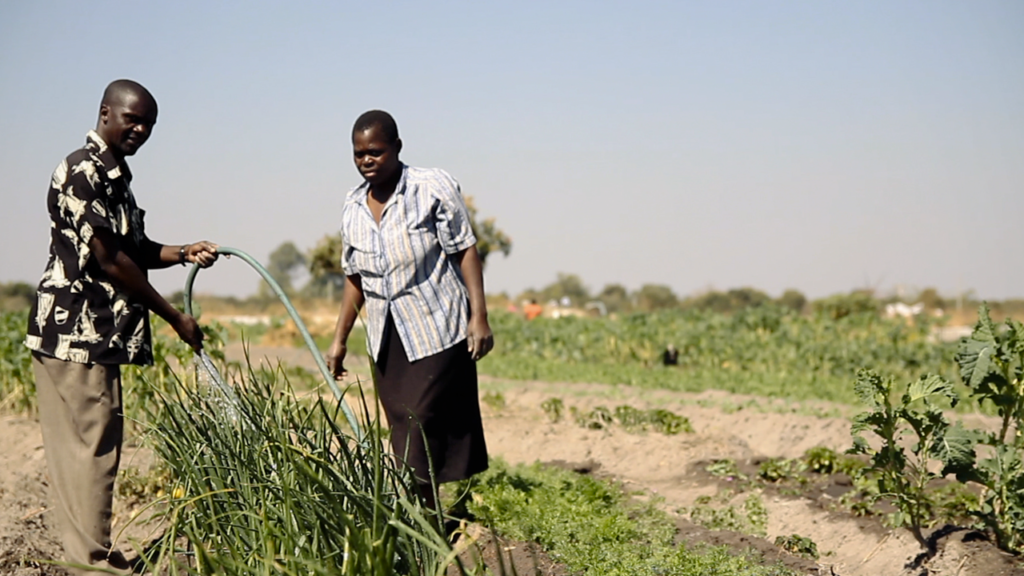
Entrepreneur in Zimbabwe (source: Luke Boney films)
My grandpa loved people well and it showed in the way he ran his business. Ethan Rietema and Steve Van Diest upend the mattress industry by providing a restful buying experience. Reyna overcame blindness to start a business that now provides for her family. Brian saves lives by selling solar lamps to hundreds of thousands of families around the world. Steve Hill and Jim Howey breathe dignity into what appears to be an ordinary warehouse. These leaders—on construction sites, shop floors and in strip malls—take the mission of God forward. They are not our extras. They are not supporting actors relegated to check-writing and church volunteerism. They are members of Christ’s body, tasked with very important jobs to do.
These remarks are adapted from a talk I gave in Washington, D.C. at Entrepreneurship in the Developing World, an event hosted by the American Enterprise Institute: Video | Polished Transcript. The event was a response to Bono’s recent “humbling” observations about the role of entrepreneurship and capitalism in helping the poverty-stricken communities of the developing world.
![Change in the Age of Shallows]()
by Chris Horst | Nov 8, 2012 | Blog |
My attention span isn’t what it used to be. While reading a terrific book last night, I noticed my itchiness for the end of the chapter. It felt forever away. The chapter ran thirteen pages. In 2012, apparently, thirteen pages is my new eternity.
Maybe you can relate: The moment you wish a 90-second YouTube video would get to the point. The moment you yearn for a red light so you can catch up on email. The moment you need to check a new text message during dinner with friends. This growing impatience dangerously impedes our ability to stick with things that matter.
I’m sure some teenage whippersnapper will suggest I’m simply recreating the tendency of our grandparents to overstate the distance they walked to school. They didn’t walk uphill both ways, always in blizzard conditions.
But our attention spans are slipping. According to a new book, our physical brains have adapted to our shared shiny rock syndrome. In The Shallows, author Nicholas Carr argues we have lost the ability to last. We skim and scan, but rarely sustain. While debate remains whether our brains have physiologically changed in the digital age, my experience certainly affirms Carr’s thesis. Maybe it’s my world-in-my-hand smartphone. Or, maybe I subconsciously yearn for the days when my dad’s car phone was a connectedness marvel. No matter the reason, I’m itchier than I was five years ago.
I wonder how our multitasking influences how we view change within people. Even Desmond, my two year old, rapidly switches between apps on my iPhone (…and no, parental purists, I’m not too proud to admit he borrows it at restaurants). I mean, goodness, he gets unruly halfway through Goodnight Moon.
Does the age of shallows stunt our patience? On a recent trip to India, I walked through a “slum among slums.” Conditions were abysmal, and I craved a “fix and flip” solution to the wrenching problems. I questioned whether I had the endurance to invest in the sort of change that demands time. I questioned whether my millennial sensibilities would allow for the sort of steady and faithful life-on-life investment needed for true growth.

We need to recalibrate to a longer view. Bangladesh cut infant mortality by two thirds and more than doubled female literacy over the past twenty years. The “rise of globalization and the spread of capitalism” halved extreme poverty worldwide over the same time. The Church spreads at unprecedented rates south of the equator. It’s not instant, but it is remarkable.
We need a personal recalibration too. Good change is rarely immediate. Friendships demand TLC. Marital harmony is more like a slow cooker than a microwave. A virtuous life is not “acquired spontaneously” but rather a “product of long-term training, developed through practice.” Desmond didn’t master the barnyard animal puzzle overnight. These good things demand the long view, but the Information Age clouds us from seeing it.
Change takes time. In a broadband world, Indian slums prompt frustration with the measured pace of change. But in the case of a wayward sibling or a forlorn slum, slow can be good. The knight on his white horse creates a scene, but he doesn’t change anything. Hitting the jackpot makes waves, not change. Healthy change is incremental and it emerges through faithfulness. In our sound byte society, we need the discipline to wait for it.

by Chris Horst | Oct 9, 2012 | Blog |
Three sentences. That’s all it took to know Reyna was extraordinary. I met her just a few days ago. Reyna’s spirit reverberated in her Dominican home and into the heart of this American visitor. And she unsettled me in profound ways with her unassuming heroism.
Reyna’s modest home fronts a dirt alleyway in the town of El Seibo, a busy city in the heart of the Dominican Republic. Life isn’t easy in her neighborhood. Deficient infrastructure, education, and sanitation shackle her community. But Reyna’s smile wasn’t lacking. She approaches life like an eager Coloradan advances on a challenging hike—with vigor, optimism and confidence. Her enthusiasm is surprising because of poverty’s grip on her city. But it is remarkable because of her impairment. Reyna was blinded at the start of her adult life. At the age of 20, Reyna lost her sight.
“God has given me so much. My job is to give back to others.”
An embarrassing lump grew in my throat when she voiced those words. Reyna was a charity case poster child. She could have starred in a Sally Struthers infomercial. Dirty water. Substandard hospitals. Single woman. Blind. But Reyna didn’t see it that way. Her impairment didn’t cloud her identity. Reyna knew she was a strong, purposeful and capable woman. She could see she was designed in the very image of her Creator.
Reyna has unhampered ambition. She launched a business and it grew dramatically. The corner Target, her store provides it all: Rice, flour, cooking oil, toiletries and more. She trusts her faithful clients to pay in full. When new customers stop in, however, she keeps their payments separate till a faithful client stops in to verify. She treats her customers with class and only sells the best products. And her business has grown enormously profitable.
Reyna
And that’s a good story: The rags-to-riches blind entrepreneur. But Reyna’s story was just beginning. She’s since taken in her sister’s two children and raised them. Her nephew now studies at the Dominican Air Force academy. Her teenage niece aspires to medical school. She is a leader at her church. While she answered my many questions, she interrupted our conversation with a phone call. That might have been rude, but in a very “that’s Reyna” sort of way, the caller was a young woman in her church who was preparing for a surgery and looking for her counsel. Reyna refuses to succumb to, or even acknowledge, low societal expectations.
“God says that, ‘Whoever is generous to the poor lends to the Lord,’ she recounted. “We’re called to be openhanded in our success and that’s what I try to do.”
It’s as if she doesn’t get it. Reyna, I see you as the poor in this proverb. You’re the blind woman in the developing country. She deflects what I might assume about her because she knows what her Father thinks about her. And she’s chosen to share in her success. She extolls everyone to embrace the gifts God’s given them.
“There a many blind people in my city that are not working. Why? They are more than capable. This is a big problem for us.”
Reyna captivated my imagination for the hour I stood in her home. She, of course, had prepared a patented dulce de leche dessert for us. And, of course, she cried several times in gratefulness for all God had given her. It’s what heroes do. Nothing fabricated and no veneers. Reyna was created to create and gifted to gift. No barrier was going to keep her from seeing that.
by Chris Horst | Sep 10, 2012 | Blog |
I sat on the countertop as my mom shared the tragic news: My grandpa—Abe Horst—had died. A heart attack seized his last breath at the early age of 63. While reading the newspaper during a summer day in 1997, he passed. He was healthy and active and we were not ready to say goodbye. While our relationship revolved around my early adolescent affinities like pizza and beach vacations, I cherished him immensely.
I have learned more about Abe in retrospect. And the more I uncover, the more I mourn. Candidly, the pain of losing him is stronger today than it was then. I’ve learned Grandpa was an entrepreneurial risk-taker and a gifted manager. I’ve discovered he grew his real estate development company from 25 employees to over 600. I’ve visited his expert craftsmanship displayed in the buildings he constructed across the Susquehanna Valley.
In an interview on his leadership approach, Grandpa shared a value he held dearly.
Our people are a joy and a blessing. Absolutely, I would say that is where our success begins. These are not just warm bodies. They are tradesmen and craftsmen who can work with their hands. They can visualize, see the picture of a finished job in their mind’s eye long before it’s completed. They’re proud of the work that they do and that shows in the work they do.
From the farm fields to construction sites to executive suites, Abe demonstrated a truth he believed: God created us to create. And he let his workers know it. At his memorial service, hundreds of past and present employees lined up out the doors to share their respects. The volume of compliments we received from these workers astonished us. I’ve learned my grandpa was known for creating abundant time—even when he was the CEO—to visit his workers and sincerely affirm their abilities.

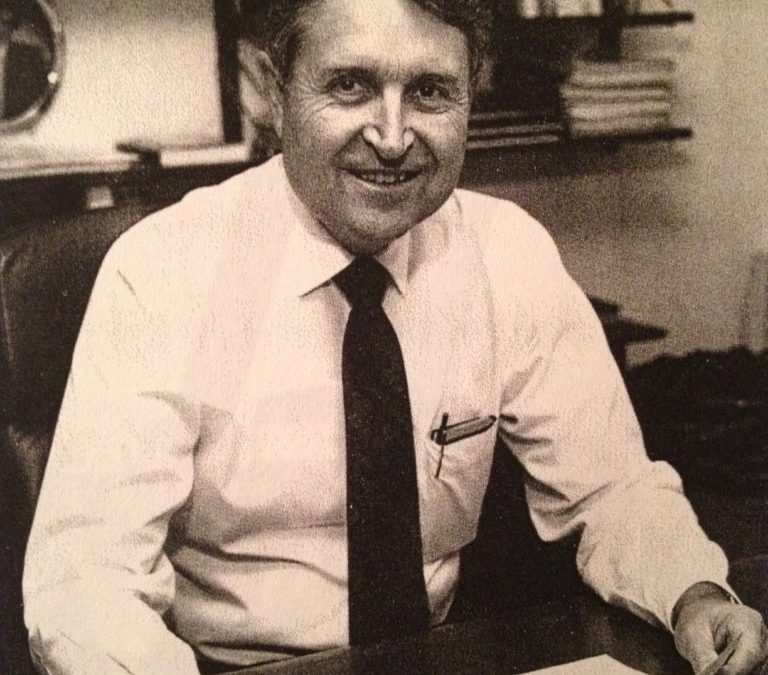
Abe Horst
Work isn’t popular. It’s our cultural scapegoat, vilified for many reasons. Most-recently, a New York Times writer, Tim Kreider, penned a mostly thoughtful column on busyness, but lamented a widely held falsity.
The Puritans turned work into a virtue, evidently forgetting that God invented it as a punishment.
When we examine our culture’s caricatures of work, it sure seems like work is cursed. We suffer through the “daily grind” because we’re “working for the weekend.” After all, “it’s five o’clock somewhere.” In our Office Space culture where companies like Dunder Mifflin are normalized, it’s easy to believe work is inherently flawed. In God’s design, though, people weren’t strumming harps on angelic clouds. The Garden of Eden wasn’t a Sandals Resort. In Eden, we see Adam and Eve meaningfully employed to tend their property. The first action God took and command he gave was to work.
Nearly all the biblical heroes of the faith practiced a philosophy of vocation that was redemptive, not resentful. Joseph’s career began in the sheep pastures and ended in the Egyptian Oval Office. Lydia designed clothing. Jesus knew his way around a woodshop. Throughout scripture, we see workers modeling creativity, diligence and purpose.
My grandfather understood this and instilled it in those around him. When Christians allow cultural stereotypes to become our narrative, we ask the wrong questions: How long till Friday? Why can’t every day be a vacation day? In a stirring Labor Day editorial, Rev. Bill Haley suggests we consider work differently:
“How is my job creating good in the world? or “How is my job helping fix what is broken in the world?”
Kreider suggests work is cursed so we should do less of it. Grandpa believed work is challenging and it’s good for us. Work isn’t an evil to be escaped. My friends who are unemployed, underemployed or retired-without-purpose all attest: It’s miserable. Work is cursed only when we relegate it to its stereotypes. Hundreds of workers came to Abe’s funeral not because he gave generous vacation time, but because my grandfather understood God intended work as a gift to embrace, not a curse to escape.

by Chris Horst | Aug 6, 2012 | Blog |
There are few people less qualified to speak at a Princeton University conference in Austria than me. Even prestigious universities make mistakes, however, and they certainly did by sending me an invitation. In the pre-conference packet, lofty bios filled whole pages. It became strikingly evident that my title looked akin to a computer programmer at a bodybuilding convention. My bio followed a former US ambassador’s. But sure, I wasn’t intimidated in the least to put my bachelor’s degree in sport management and 2.5 years of professional experience to work.
The Woodrow Wilson School of Public and International Affairs at Princeton University (or TWWSOPAIAAPU for short) hosted the conference on the topic, “Faith and International Development.” They convened leaders from international organizations (like mine) as well as policy-makers and academics. We hailed from many faith and non-faith persuasions and enjoyed a week of Austrian culture together. And we debated amicably. There was only one guy there who rankled me. And he also happened to be the only other representative of a Christian faith-based organization.
His offered an irksome commentary on a subject I care about deeply. The crux of his message? Christian evangelism is dangerous, paternalistic and wildly inappropriate. He argued the sanctuary is the only venue where Jesus-talk is permissible, castigating international organizations with the audacity to claim otherwise. And I couldn’t disagree more. To this guy and those who think like him, evangelism (or, as he labeled it, proselytism) encroaches on modern sensibilities. Talking publicly about faith, he stated, is wrong. And he’s not alone. His views resound through the chambers of the elite and educated. Together, they dance to the inclusive harmonies of tolerance and diversity.
But my comrade fell into the very trap he lectured us to avoid. He advocated we sanitize our religious views from our work and lives. He reasoned matters of faith are personal, not public, and demanded we keep our religious opinions to ourselves. But all the while, he wasn’t offering some impartial perspective. He wasn’t living above the spiritual fray. He advocated for neutered convictions …as if he held no convictions at all?
Skeptics believe that any exclusive claims to a superior knowledge of spiritual reality cannot be true. But this objection is itself a religious belief…It is no more narrow to claim that one religion is right than to claim that one way to think about all religions (namely that all are equal) is right. – Tim Keller, Senior Pastor, Redeemer Presbyterian Church
I believe in civility and playing nice. This isn’t about ramming faith down throats or threatening fire-and-brimstone. I’m fighting for honesty. When we demand faith be bleached-out from our work, we commit the sin we scold against. My conference colleague tossed grenades at proselytism while attempting to convert me to his position.
[Proselytism] is virtually unavoidable: Almost everyone is a proselytizer on behalf of something… It may be possible for those almost or entirely without connection to others (hermits, those at the far end of autism or Alzheimer’s, long-term coma patients, and so on) to avoid proselytism completely; but otherwise we are all proselytizers. – Paul Griffiths, professor of Catholic Studies at the University of Illinois
I’m grateful my conference peer held such passionate positions. I will advocate for his right to share them. But it is self-defeating to demand some impossible form of sanitized society that inhibits religious discussion, as if the common man might somehow be duped into conversion. I believe in the life and promises of Jesus of Nazareth. And our world suffers if anti-evangelism evangelizers stifle me from sharing it.



