Finding a positive news story is a formidable task. Finding a positive news story about business is a nearly impossible task. Ponzi schemes, Hollywood’s corporate caricatures, and lavish executive bonuses define our perceptions. Examplars are one small we can all undercut the negative onslaught.
This story isn’t just inspiring–it’s personal. Mary Wolgemuth is my courageous and compassionate mother-in-law. Her survival story (as articulated by my father-in-law) reminds me that no job is just a job. And that no company just makes widgets. From the skilled chopper pilot who whisked Mary to her hospital to the medical engineers who designed the bolts that now hold her bones together. From the florists who arranged her hospital room bouquets to the gentle Southwest flight attendants that smoothed her path home to Denver. Bell Sports is just one player in the team of people who preserved Mary’s precious life during these arduous weeks: A beacon of entrepreneurial excellence.
—— An Open Letter to Bell Sports
Mary Wolgemuth has been my wife for over 34 years. We live in Colorado and we love to ride and hike together. On July 10, 2012 we were in Anacortes, Washington intending to do some riding with family for a few days. After roughly 25 miles of riding Mary lost her balance and fell into the path of a passing pickup truck. I was immediately behind her and witnessed her crashing to the pavement.
She was unconscious when I got to her. In ten minutes an ambulance arrived and shortly after that Mary was airlifted to Harborview Hospital in Seattle. Skilled doctors put her pelvis back together, while her fractured ribs and collarbone will have to heal on their own.
I firmly believe that God spared the life of my wife – but He used a Bell bike helmet to get the job done. The attached pictures show the compression in the area of the left temple of Mary’s helmet. She didn’t scrape on the ground but was pounded directly into the surface. It cracked her helmet in at least a couple of places… but it did what we needed it to do.
Mary’s Bell Helmet
I am deeply grateful to the Bell Helmet company for the protection provided to the head of my wife. You have given me my wife back, and I will be forever grateful. To the engineers who designed this, to the salespeople that got it placed at Performance Bike, and to the business people that helped to price this at a point where I could afford it… Thanks, a thousand times thanks.
God bless you and grant you much success in the days ahead.
Dan Wolgemuth
President/CEO, Youth for Christ USA
Timothy Kayera spoke with been-there-done-that confidence. He grew stronger with each word, pulling me closer with the fire of his conviction. And then he summarized everything I believe about charity. In four words.
I used to work with one of those organizations that gave stuff away to everyone. We’d give away animals, clothing and clean water. All for free. I remember when we’d give goats to people, I would get phone calls and they’d say, “Timothy, your goat is dead.”
Your goat is dead. I’ve tried to articulate this idea dozens of times over the years, but never this potently. In four words, the caller said:
It was never his goat in the first place,
It was inconsequential it died, and
It was Timothy’s job to replace it.
Kayera is a star in Rwanda’s promising cast of young leaders. He directs HOPE’s efforts in a region of Rwanda and he emphasized the difference of his new job. His work now creates dignity, not dependency. Partnership, not pity. Timothy joins a chorus of Rwandans in this song, from the president of the country to “Rwanda’s Desmond Tutu.”
[The poor] are as capable, as competent, as gifted, and as talented as anyone else…In society, you must create opportunities to help people develop their capacity and talents. – Paul Kagame
We need to move from aid to production, from existing to living. It’s high time we stop telling our people they can’t do it. They can, yes. And we shall do it. – Bishop John Ruchyahana
Timothy, President Kagame and Bishop Ruchyahana share this opinion: Traditional charity erodes the nature of people and the fabric of society. When giveaways permeate, they communicate a clear message: What you lack, I provide. Where you are weak, I am strong. When you can’t, I can.
It’s a bad message, preventing people from hearing the better message from their Creator: I made you to make. I designed you to design. You are blessed to bless others. When charity runs its course—as it has in many places in Rwanda, Haiti and elsewhere—it lures the poor with handouts and traps them on unneeded life support.
But that’s why Timothy got out of that business. He saw its destructive path and cut the cord before it strangled. Today he anchors his work on who people are created to be and what we are designed to do. He doesn’t lure with goodies. Instead, he demands hard work from those he serves. People like Rachel.
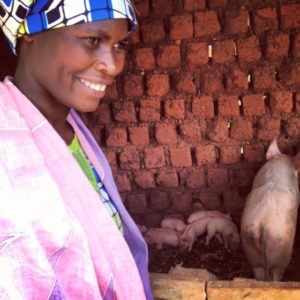
I saw the future of Rwanda in her. Rachel showed me the house she built and the 16 pigs she purchased over the past two years. She showed me the litters of piglets she’s bred and the piles of fertilizer she sells. But Rachel isn’t filling her barns for herself. I asked her what her dreams are and she said, “The greatest joy of these pigs is that I am now able to share with my church and with others.”
Rachel
Rachel didn’t beg for cash or stoop in compliance. She stood tall as a confident merchant, wife and mother. She did not avert her gaze. Her eyes were strong and generous. Rachel wasn’t the product of charity. She simply knew who she was created to be.
My day job transports me beyond our nation’s borders every morning. I rally our supporters to unleash grassroots entrepreneurs in places like Bujumbura and Lubumbashi. But, I live in Denver. I walk these streets. So when it comes to my town, who do I cheer for (apart from Tim Tebow, of course)?
Many great organizations serve our city. We need important agencies like Joshua Station and Providence Network that protect our city’s most-vulnerable families. What energizes me most, however, are entrepreneurs at the margins. I’m drawn to the innovators that give job opportunities to those who typically go without. These two great organizations inspire me:
An open industrial garage door invites discount-hunters into a nondescript warehouse in northeast Denver. Inside Bud’s Warehouse, profundities of all varieties are commonplace. Bud’s, a home improvement thrift store, hires the unhireable, mostly former felons. They repurpose construction site leftovers and lighten the load on landfills by selling these products to deal-hunting contractors and home remodelers.
Each morning, the Bud’s team gathers for a “hood check” to discuss faith, family and work. Bud’s is the cornerstone business of the Belay Enterprises portfolio. But, after growing Bud’s into a $2 million business, they launched new ventures including a commercial cleaning company, a baby clothing consignment store, an auto garage, a jail-based bakery and a custom-woodworking business. Together, these businesses help rebuild lives and create immense value in our community. The masses–including major publications like Christianity Today–are starting to catch the Belay fever.
They aren’t based in Denver, but Jobs for Life recently sank roots into Coloradan soil (and they’re probably in your city too). Throughout the Mile High City, many unemployed and underemployed people are rediscovering their purpose through Jobs for Life seminars. God designed people to apply their hand to a craft, to work hard and to yield fruit from their labor.
Especially in this socioeconomic climate, we need to recapture this message. Even many good-hearted charitable efforts stifle our design as workers. We forget we are co-creators with the God who toiled for six long days to create the galaxies and ecosystems. Jobs for Life helps our communities rekindle the message of work. Their new video communicates this better than I can:
Entrepreneurship is in my blood. I visit places like Bud’s Warehouse and am inspired by their creativity, profitability and impact. Who inspires you in your city?
The battle rages on. Across the globe, forces for good assault a great evil–human traffickers. Ruthless, shifty and complex, our formidable opponent lurks in red-light districts and shantytowns.
“More children, women and men are held in slavery right now than over the course of the entire trans-Atlantic slave trade…generating profits in excess of 32 billion dollars a year [GDP of Costa Rica] for those who, by force and deception, sell human lives into slavery and sexual bondage. Nearly 2 million children [population of Houston] are exploited in the commercial sex industry.” – International Justice Mission (IJM)
Leaders rally coalitions to combat villains who perpetrate these crimes on innocent children. Pioneers like IJM and Not For Sale convene activists and churches to fight this injustice. Together, they bring freedom to the darkest corners of our world. I pray these organizations grow. I pray justice is served. I rejoice with each girl whose chains of bondage break. And, I mourn to think of the many who are not yet free.
These pioneers are not without allies, however. On the front lines, a quiet hero is emerging. Inconspicuous, yet powerful, their chief ally wages war often without even knowing it.
Our hero? A good job.
Perpetrators rarely kidnap girls off street corners. More often, they lure girls into slavery with job offers. This explains why the poorest neighborhoods in the poorest countries are at greatest risk. Traffickers swarm in slums, offering parents a shot at prosperity. Give me your girl and I’ll get her a call center job across the border. They bait desperate families with financial opportunity.
Poor families are the bull’s eye for traffickers. Fewer poor families means fewer girls sold into slavery. How many parents in your neighborhood have gifted their daughters away to job placement agencies? Traffickers ignore our towns because our families aren’t starving.
Last month, I visited HOPE’s work in southern Asia. We work in a city known as a regional hub for the trafficking industry. I met with dollar-a-day families in slums throughout the city, watching our local staff breathe life into the oppressed. James, our country director, hates that his city is a target.
“We train the 6,000 families we serve how to spot a trafficker. And we help them start and grow businesses so the trafficker’s bait is irrelevant,” Jon told me.
HOPE International clients
Motivated by his faith to bless an at-risk place, my friend, Rick, recently opened the doors of a “trafficking-fighting agency” (pictured below) in another trafficking hotspot, Vietnam. This agency, a manufacturing facility, employs over 100 Vietnamese people. Linh, a beautiful young woman who was trapped in prostitution, now manufactures medical devices. She left a career of slavery for a life of freedom. The job changed her course forever.
Rick’s “Trafficking-Fighting Agency”
The CEO of a medical devices business, Rick doesn’t sign petitions and he doesn’t raid brothels. Instead, he creates opportunities for dozens of people to engage in dignifying work. His business provides an upstream, economic solution to an economic problem by putting traffickers out of business.
“I think our Vietnam operation will surprise us and become more than we’ve dreamt. We reflect Christ’s purposes in this place: To be God’s instruments to reclaim, to reconcile, and to redeem. To make all things new. That’s why we are here.” – Rick
In the war against trafficking, we need to deploy more than activists. We need to deploy an even greater force against our imposing foe. We need to unleash our secret heroes—the job creators. We need to affirm the big businesses, mom-and-pop shops, and social enterprises that create good jobs. We need to unlock the creativity of the human spirit to build new job machines, enterprises that strike the engine of the trafficking industry. We put the very fear of God in the heart of evil when freedom-fighters like IJM join arms with freedom-fighting job creators like Rick and HOPE International.
Over the past eight days, I boarded thirteen separate flights as I hopped across the Asian continent. I spent the most time in India. Actually, I spent time in “both Indias,” a phrase my Indian friends used. I visited the skyscraper-heavy financial district in Mumbai and met families in slums nearby. I drove past the most expensive house in the world and walked through one of the world’s poorest shantytowns. Both Indias.
As a connoisseur of fine airlines (e.g., Southwest, my favorite), India’s airlines impressed me. I flew Jet Airways several times and they did everything right: Prompt departures, quick boarding, no fees, and friendly service. It was hard to believe this upstart airline didn’t exist just seven years ago. Actually, seven years ago, there was only one airline in the country: Air India.
Air India – Source: iFreshNews
Until 2005, the Indian government held a monopolistic stranglehold on the aviation industry. Air India was the only show in town. And it was a really bad show. Prices were sky-high, service was terribly low and Air India consistently lagged in innovation. It is a classic story of government-intervention-gone-wrong.
The real victim of Air India’s failure, however, was the poor. Not only could they not afford to fly, but they also were continually forced to bail out the floundering “business.” As taxpayers, they were on the hook for Air India’s failure. Created under the auspices of “protecting the Indian people,” Air India did exactly the opposite. The vitriol for the company by the people of India is apparent. On my final flight home, I thumbed through the pages of The Telegraph, an Indian newspaper. The editorial title about the airline summarized the country’s sentiment: “A long, sordid and pathetic tale of failure.”
Riddled with inefficiencies and waste, Air India was actually crippled while I was in the country. The entire staff has gone two months without salaries and they were on strike last week. The editorial reviled in the failures of the airline, noting for example, that they recently purchased new planes without doing any price negotiation whatsoever with the manufacturers.
Jet Airways and a handful of other upstart airlines like IndiGo are charting a different and refreshing course, however. Led by aggressive Indian entrepreneurs, these budget airlines deliver on their promise to customers. And, they bring abounding opportunity to the poor. The data doesn’t lie: Since 2005, air traffic in India has tripled, fare prices have dropped dramatically and the quality of service has increased.
I’m an admitted believer in the power of entrepreneurship and the free markets. While not without its warts, I’ve argued that capitalism is the “best broken system” for the most vulnerable in our world. There is a role for government in helping the poor, but Air India illuminates that sometimes the best social service they can do for the poor is unleash the Indian entrepreneur to be the solution. Jet Airways, IndiGo and SpiceJet are up for the challenge; and the world is opening up to low-income Indians as a result. SpiceJet’s motto says it all, “Flying for Everyone.”