This post is a stop on the Lenten Blog Tour, which brings the story of Jesus and the Christian tradition of lent to you through the lens of a new Bible translation, the Common English Bible, and 41 different voices. ————————————————————————————————- Having loved his own who were in the world,He loved them fully. – John 13:1
The backdrop for the events which follow is seen in the first verse of John 13: “He loved them fully.” This is the context, the setting, the foundation for what comes next: The night Jesus cleaned the filthy feet of his friends as he prepared to bear their pain on the cross.
Having loved fully, Jesus provided food when the stomachs growled.
Having loved fully, Jesus calmed the seas when they were in turmoil.
Having loved fully, Jesus answered foolish questions with grace.
Having loved fully, Jesus shared truth, broke bread, and fed their souls.
Having loved fully, Jesus stooped down to clean their weary feet.
Having loved fully, Jesus gave himself so they–we–could be forgiven.
He loved them fully. As we ponder this statement, our thoughts drift to times when we’ve been loved fully.
Having loved fully, our parents said no when we thought we wanted them to say yes.
Having loved fully, Matthew made us laugh in moments when he knew we needed it.
Having loved fully, Grace taught Scripture in a way that children could grasp.
Having loved fully, Amy set aside the busyness of her day to connect over a wonderful meal.
Having loved fully, Jesus sought us out in moments when we sought everything but him.
During this season of Lent, comfort-seeking gives way to reorienting. We are called to reorient our lives to resemble Christ, with both our heart and our hands. Insert a name and ponder whether it resembles Christ: Having loved ______ fully …what happens next?
Having loved our neighbor Sylvester fully, would we bustle into our house when he’s sitting on his lawn chair? Would we turn up our noses at his foul language? Would we attempt to fill the empty chair at our dinner table with someone just a bit more safe?
Having loved Sylvester fully, would we pick up the trash which blew over from his lawn? Would we bake him fresh bread just because? Would we engage in conversation when we don’t have time to do so?
The love of Jesus begs a response. Having been loved fully, how will we fully love? John 13:1-8, 12-15 (CEB)
1 Before the Festival of Passover, Jesus knew that his time had come to leave this world and go to the Father. Having loved his own who were in the world, he loved them fully.
2 Jesus and his disciples were sharing the evening meal. The devil had already provoked Judas, Simon Iscariot’s son, to betray Jesus. 3 Jesus knew the Father had given everything into his hands and that he had come from God and was returning to God. 4 So he got up from the table and took off his robes. Picking up a linen towel, he tied it around his waist. 5 Then he poured water into a washbasin and began to wash the disciples’ feet, drying them with the towel he was wearing. 6 When Jesus came to Simon Peter, Peter said to him, “ Lord, are you going to wash my feet? ”
7 Jesus replied, “ You don’t understand what I’m doing now, but you will understand later. ”
8 “ No! ” Peter said. “ You will never wash my feet!”
Jesus replied, “ Unless I wash you, you won’t have a place with me. ”
12 After he washed the disciples’ feet, he put on his robes and returned to his place at the table. He said to them, “Do you know what I’ve done for you? 13 You call me ‘Teacher’ and ‘Lord,’ and you speak correctly, because I am. 14 If I, your Lord and teacher, have washed your feet, you too must wash each other’s feet. 15 I have given you an example: just as I have done, you also must do.
It was a moment when personal convenience trumped common decency. Desmond, our six month old, was in his cheery post-feeding bliss. And, as I moved him through our hotel room, Desmond performed a response not uncommon for full babies: He spit-up. And the carpet caught the brunt of his act.
It was in this moment where I miserably failed a test of honor. I simply and soullessly watched as the spit-up pooled on the hotel’s beautiful carpet. Without any ethical reservations, I smushed the spit-up into the carpet fibers with the sole of my shoe. With just a few spineless swipes, Desmond’s deposit disappeared. I can’t even pretend I waffled with the decision. The whole sequence lasted just seconds.
Since that regrettable moment, I have attempted to identify what motivated me to do it. Despite its incivility, there have to be at least meager grounds for what I did. This is what I know: I would never have done that in my own house. In fact, I recounted a number of home floor-scrubbing memories, moments where I busted out specialized cleaning products and bristle brushes to clean even minor blemishes, exhausting my arm and back muscles in the process.
Ownership was the difference between these Mr. Clean moments and the hotel room villainousness. I am deeply committed to maintaining my home. It’s a place where I have invested personal energy, money and time. The hotel room, however, was just rented space. I knew I would never see that room again, so I was unconcerned about the long-term cleanliness and vibrancy of the hotel’s carpet.
While I am deserving of scorn, don’t furrow your brow at me just yet. You’re no different from me. I’m betting you’ve Andretti’d more than one Hertz rental in your lifetime. Or, perhaps you’ve left a bathroom stall in a condition which your mother would not approve. The principle applies beyond carpet stains. It’s the reason dormitory bathrooms teem with innumerable bacterial varieties. It’s why my fellow Coloradans feel no shame in abusing their rental skis while shredding the mountain. It’s why old Soviet apartment buildings look worse with each passing month.
At HOPE, we are committed to not dictating to our entrepreneurs the type of businesses they should start and run. We avoid coaching them into specific ideas for the same reason I vigorously scrub our home’s soiled carpets. If we conceive it, they don’t own it. Business challenges become as dismissible as hotel room infractions. When our clients pursue their own dreams, no stain—a rough sales month or tough weather—is uncleanable.
I hated the first commercial break. Just ten minutes into the show, Alli and I were instant evangelists for our new favorite show: America’s Next Great Restaurant. It’s everything good from The Apprentice–entrepreneurship, hard work, and real people chasing their dreams–minus everything really bad about The Apprentice–Donald Trump’s ego, superfluous drama, & The Donald’s hair.
Photo source: Hulu
The concept is simple: “People from every walk of life will vie for the opportunity of a lifetime to see their original restaurant concept spring to life – starting with the opening of a restaurant chain in three locations – Hollywood, Minneapolis and New York City.” It’s a ramped-up business plan competition planted in the fast casual (e.g., Subway, Panera, etc.) food industry.
Be warned, this show induces stomach-rumbling, but aside from that, we see no weaknesses. So much to love, but here are our highlights: It’s entrepreneurship at its best: Our economy desperately needs fresh ideas, and the data is clear: It’s gonna have to come from new small businesses. This show gives a glimpse into what it takes to translate a fresh idea into a viable concept. The pilot episode was an entire business school crash course. The contestants pitched their concepts and discussed pricing, differentiation, innovation, and leadership with the talented crew of judges. Speaking of which… These are great judges: No token old British guy. No brainless celebrities. These four judges compose a savvy, experienced and inspired panel. The headliners are Bobby Flay, Food Network phenom/burger artist, and Steve Ells, the founder and CEO of our country’s undisputed top restaurant chain — Chipotle. Bobby is the chops and Steve is the genius–a tandem cowering above the likes of Abdul & Cowell. The judges are the investors: This is the show’s most unique concept. The judges aren’t just critiquing the contestants and their concepts to conjure-up oohs and ahs. They are determining whose name is on their respective checks as the winning contestant will be funded and coached by the judges themselves. They have skin in the show.
Sure, there are probably better things to do with an hour each week than watch a TV show. You could plant a tree, read a self-help book, or knit a sweater. But, nobody plants trees at night or actually helps themselves after reading self-help books. And, you can knit your heart out while still watching the show.
To boot, this isn’t Skating With The Stars. It’s Hollywood at its best–an educational and inspirational delight. Like The Social Network, I finished watching compelled to create. To innovate my own restaurant concept (..and I do have a great concept). If I were Bobby Flay, I would be high on Joseph Galluzzi and his grandma’s meatball recipe. Maybe I’m going out on a limb (can you really build a restaurant around a meatball?), but watch for yourself and convince me why you wouldn’t invest in Joe. Like the show and the judges; he’s the real deal.
[vodpod id=Video.5721398&w=500&h=413&fv=]
TOMS Shoes defines cool. These hip slip-ons are the garnishment of urban hipsters, but even much-less-cool folks like me love when companies give back. The winning equation for TOMS has been the “buy one get one” approach they pioneered: You buy slick kicks…and poor kids get free shoes. This equation has propelled TOMS to corporate superstar status.
All companies practice and celebrate their do-goodism. There’s even a cumbersome title for it–corporate social responsibility (CSR). Analyzing corporate charity models is one of my hobbies. Today’s doing good battle is between TOMS Shoes, the hipster heavyweight, and Whole Foods Market, the granola momma’s utopia.
VS.
—-
TOMS: Lots of good, but some areas that could be tweaked. Please: Don’t chuck your TOMS at me just yet. Hear me out. The good: They connect their product–shoes–to their charity–shoes for poor kids. Rather than supporting something entirely unrelated, like well-drilling in Africa (leave well-drilling to Aquafina and Dasani), TOMS’ charitable endeavors are a foot-in-shoe fit, you might say, with their business. Needs Improvement: First, though fabulously intended, I’m in the choir of skeptics about the impact of distributing free shoes to poor kids. In short, giving away free stuff, whether its TOMS Shoes, school supplies, or castaway Super Bowl t-shirts, almost always has a negative long-term impact on local economies.
Second, their social mission is sold as an add-on to their business. Like many other companies, they slice off a share of revenue and use that to fund charity. Giving is a good thing, don’t get me wrong, but companies like TOMS celebrate the toppings rather than the sundae itself. They splash a “charity cherry” on top of their business, but often neglect to acknowledge the core contribution they make to society: Providing meaningful jobs and cool shoes to our world. Whole Foods Market: Though much more nuanced than TOMS, their approach to doing good is “best in class.” The good: On a recent trip to Whole Foods to buy a bouquet of flowers for Alli, I left deeply impressed with the way their charitable efforts are woven into their core business: Selling healthy, fresh groceries. Rather than highlight their food donations, or the food relief agencies they could financially support, they celebrate the livelihoods they support across the globe and the nutritious goods they provide to their customers. I got this simple flyer with my flower purchase featuring Alfredo, one of the farmers:
Let’s be clear: Whole Foods profits from my purchase. They are not motivated to work with Alfredo solely because they want to help the vulnerable. They work with Alfredo because he grows gorgeous flowers and enables shareholders to earn big returns.
Still, they do business with Alfredo in a redemptive, equitable way, shedding light on the real people–the breeders, bakers and butchers–who produce their groceries. Like Whole Foods, Starbucks shines as a kindred spirit in the way they treat and celebrate their 75,000 coffee farmers. The verdict: Like TOMS, Whole Foods gives a percentage of their revenue to provide additional support to farmers like Alfredo, but that becomes cursory, their add-on, to the livelihoods they support. Rather than voicing poetic kudos to their corporate tithing, Whole Foods highlights the inherent and more significant value their business brings to our globe. The clear winner? Whole Foods. They do good well.
At first glance, the article reads like a first-hand account of a post-disaster country: “Streets once devoid of commerce in towns like this and in Havana are gradually coming to life…” The scene Victoria Burnett described in her New York Times article was not of a country recovering from a natural disaster or civil war. Instead, it depicted her journey through Cuba, a country whose people have been reawakened. She experienced the buzz of vibrant entrepreneurship: Unshuttered storefront windows, machinery re-tuned and whirring along till late in the night, rich smells of freshly-ground coffee beans, and the hum and excitement of restaurateurs promoting their newly-minted menus.
Cuba gives us a real-time snapshot into the spirit of innovation. For decades, unrealized dreams and untapped abilities were locked within the failed Cuban socialist system. The government-imposed chains have now been cut loose. In a move of genuine humility (at best) or desperate self-preservation (at worst), Cuban leaders have admitted that the Cuban people are better positioned than their government to innovate and to address their country’s problems.
The Cuban rebirth unearths the soul of HOPE International’s work. At the core, we believe that God—the innovator of the solar systems, mountain ranges, and human emotion—has planted a glimmer of his creativity in us. When given the opportunity to do so, people will put that gift to work. Architects, chefs, artists, entrepreneurs, electricians, florists, educators and scientists each apply their God-given creativity in uniquely profound ways. Now, for the first time in decades, Cubans have the chance to do the same.
Photo source: Jose Goitia, The New York Times
Our role as those with abundance is to do more than solely provide for those in need. Our calling is far greater than providing food for hungry bellies and medicine for sick bodies. We are surely called to do these things, but also called to unleash the God-given creativity of those in need. To fuel the imaginings of those without the privilege of exercising their creative muscles.
As I watch Cubans taking small steps toward these ends, my spirit is energized. Tomorrow, I will fly to another Caribbean nation – the Dominican Republic. While there, I will observe the fruits of Dominican innovation. I will feast on slow-cooked and fantastically-marinated rice and beans, enjoy the sweetness of freshly-harvested fruit smoothies, and perhaps purchase a bottle of home-brewed shampoo. I will meet entrepreneurs who are using the abilities and engaging the dreams which God has sowed within them. The Dominican economy and its people are flourishing. Let’s hope Cuba is right behind them.
There is a subtle, but at times blatant, message which has flowed from the pulpits and lecterns in our churches and universities. The message is this: Our world is increasingly poor, accelerated primarily by the rise of global capitalism and its chief culprit, “big business.”
An anthology of leading Christian thinkers described capitalist economies as a tyranny. The authors went further to indict capitalist economies as wholly “antithetical to the gospel.” One of the contributors, Marcelo Vargas, did not guise his critique:
In the beginning, [it] appeared to be a blessing, but it is a blessing that has been transformed into a curse.
It is really easy to throw stones at capitalism. Vargas and others cite stories of ruthless sweat shops, unbridled consumerism, Ponzi schemes, extreme income inequality, and gluttonous Wall Street executives. There are undeniable flaws, abuses and inequalities within our current economic system. However, if you are at all concerned about the poor; then this system is absolutely the best one we’ve got.
In spite of its flaws, many of which are heinous, the increasingly connected global marketplace is undeniably the best broken system–and its positive impact on the lives of the poor far exceed any system we have seen in our world’s history. The problem with many of the sweeping condemnations of capitalism is that they castigate capitalism based on its villains rather than by its record.
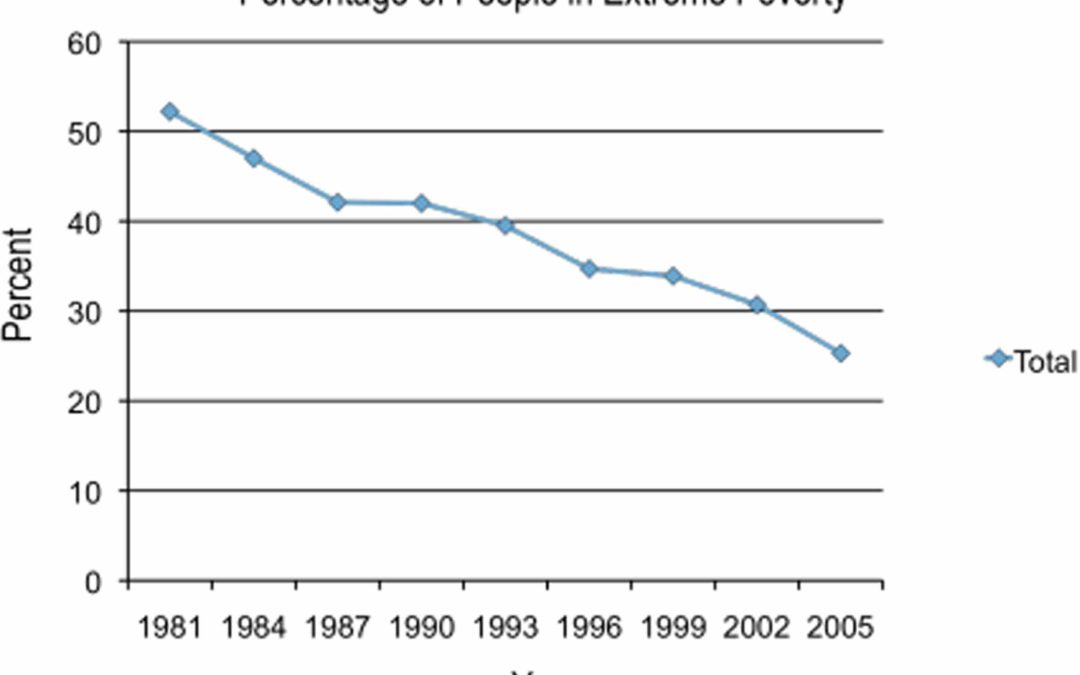
The most critical measure of success, a literal “life or death” statistic, is one that examines whether the world’s most vulnerable have escaped extreme poverty. To that point, and contrary to what many of the its loudest critics proclaim, extreme global poverty has been cut in half over the past 25 years and opportunities for the poor to progress have grown exponentially.
Source: 2009 World Development Indicators, World Bank
In a recent theology conference at Wheaton College, theologians Dr. Brian Walsh & Dr. Sylvia Keesmat described capitalism as “crucifixion economics” and went on to say that “Greater prosperity for [the United States] or its rich neighbors…will not and cannot result in a more peaceful planet.” They slammed global markets and encouraged Christians to withdraw, suggesting that when the rich get the richer, the poor will surely get poorer. I guess my question is this: Just who is being crucified in our current global system? Over 1.4 billion people have escaped extreme poverty over the past 25 years.
Global capitalism has provided unprecedented opportunities for innovative economic development and transformative missions. Tens of millions of families have escaped extreme poverty on its back. Professor, Hans Rosling, statistician extraordinaire, articulates this progress beautifully in this four minute clip–illuminating that by every measure (child mortality, life expectancy, etc.), enormous progress has been made.
On the flip side, Rosling’s data highlights that the poor in the countries which have chosen to practice an anti-capitalist economic models (e.g., North Korea, Cuba) have not fared as well as they have in capitalist and pseudo-capitalist (e.g., China) economies. Even Fidel Castro admitted the failure of his system just two months ago, when he said, “The Cuban model doesn’t even work for us anymore.” The poor in emerging capitalist economies like Rwanda and India have a different story to tell, as millions have bootstrapped their way out of extreme poverty.
Collectively, we have two options: We can vilify capitalism till the end of days, or, we can be citizens of redemption–salt and light–bringing healing to the brokenness which exists in our current broken system while also being honest about its incredible successes. We can start and run “best of class” global businesses, provide entrepreneurial opportunities to the poor, invest in businesses which do things right, and give generously to the vulnerable. This is the message which should resound from our pulpits and lecterns.