by Chris Horst | Nov 17, 2009 | Blog |
This is part one of a three-part series, “How Then Shall We Help?”
“It was an amazing mission trip. I can’t tell you how happy and content all the people were despite how little they had.”
Have you heard comments like this before? Have you said this before? I have said it several times. It’s a recurrent reflection after trips to poor countries because it is compelling to see joy in the faces of children, parents and grandparents despite their modest means. I specifically remember a joyful little boy from my last trip to the Dominican Republic who was running around wearing nothing but a ratty, tattered t-shirt. His face was dirty, he had few possessions, but, in the midst, he was content.
I have been thinking a lot about this the past few months. Christians in this country, I think, recognize we are called to help the poor. Biblically, there is almost no book in scripture devoid of God’s commands to care for the less fortunate. And, even in our secular culture, it is in vogue to care about “social justice.” It is hip to care about Africa and to buy fair trade coffee. My concern is in the outcome of this groundswell of excitement in “giving back.” I believe the end-game for Christians, often, is supporting any program, project or initiative which increases the prosperity of the poor.
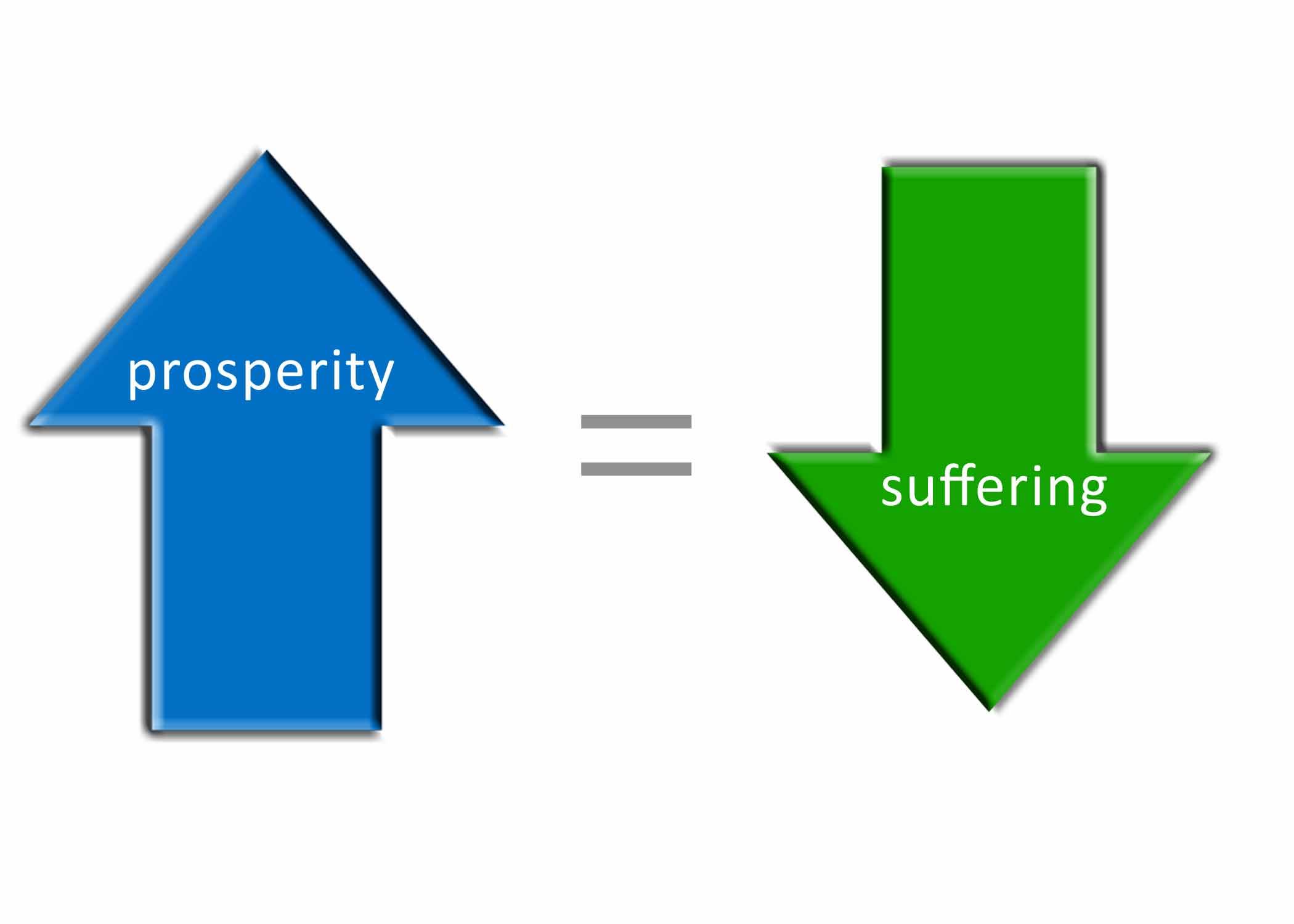
The line of reasoning goes like this: Increased prosperity leads to decreased suffering.
At first glance, I agree with this statement. There are poor people in this world. As Christians, we are called to help them out. We help them by providing education, medical care, housing, language training, business loans, savings accounts, and clean water—all to help them increase their prosperity. As a result, this line of reasoning states, their suffering decreases. Increased prosperity leads to decreased suffering, right?
What if, however, when we help those poor, happy, underprivileged families by providing them with things, they develop some of the same issues our over-privileged children have? Entitlement, jealousy, materialism, obesity, greed. What if, in our attempts to help, rather than decreasing it, suffering just takes on a new identity? I believe most American Christians would agree that increased financial prosperity does not lead to increased fulfillment. We do not have to look beyond our own families and friends to know that material wealth has very little influence on personal joy, satisfaction or success. But, it seems to me that reality has little bearing or influence on our attempts to help the poor.
Now, don’t get me wrong. I work for an organization which helps the poor. I absolutely believe we are to sacrificially serve and “give back” to those in our communities and to those around the world. But, just helping people increase their prosperity cannot be our end-game. In fact, helping the poor does not always decrease their suffering. Next month I will continue to explore these issues while grappling with the question: How then shall we help?

by Chris Horst | Oct 22, 2009 | Blog |
I love online banking and e-commerce. I love the convenience of checking account balances, making transfers, and purchasing products in sweatpants from my living room. I’ve quickly become accustomed to the ease of doing business from home, although this luxury is unique to the past decade. It’s easy to forget that just ten years ago online banking was nothing but a dream.
Last month I visited HOPE’s work in the Dominican Republic. There, I had the privilege of meeting our clients, seeing their businesses and soaking in the culture of a country I have come to love. One of the questions I asked to a few of the community banks (groups of 15-30 clients) was “Why HOPE? Why did you choose to become a HOPE client?” Time and time again, in different communities throughout the country, our clients responded, “Because HOPE came to us.”
It’s hard to think back to what life was like ten years ago, when we had to drive to the bank or the store for just about everything. It’s even more challenging to imagine how extremely inconvenient it would be if we lived a few hours from the center of town, where a trip to the bank or to the store meant a day’s worth of travel. Yet, this is the reality for many of our clients. In Congo, our clients often live two or more hours away from the closest commercial banks, large stores, and even HOPE branch offices. To service these remote communities, our loan officers must travel two hours by bus on shoddy dirt roads or, during the rainy season, traipse hours by foot through the mud to reach these communities.
In that context, you understand why they list it as a primary reason for choosing HOPE. Our hardworking and diligent loan officers go into the communities where our clients live. This is about even more than convenience. That message—No, don’t come to us. We’ll come to you—speaks dignity, loud and clear, into the lives of our clients and into their communities. They matter. Their neighborhoods are not forgotten. When everyone tells them they aren’t, we tell them they are worth our time.
One client’s comments are still ringing in my ears. I asked him, “Why HOPE?” …and he responded, “When everybody else makes us come to them, you come to us.”

by Chris Horst | Sep 23, 2009 | Blog |
Lancaster, Pennsylvania is the home of Auntie Anne’s pretzels, the nation’s oldest-running farmer’s market, and HOPE International. It also has one of the largest Amish communities in the country. Recently, while in Lancaster, I visited Costco and noticed hitching posts in the parking lot where Amish customers could park their buggies.

Costco is headquartered in Seattle, Washington. While I can’t verify this, I’d guess that Lancaster is their only store with hitching posts. If Costco had used one of their standard site plans, that detail would have surely slipped through the cracks. Only through soliciting the input of Lancaster residents could they develop a strategy relevant to the local economy and culture. By bringing in the expertise and contributions of individuals familiar with the Lancaster market, Costco developed an appropriate and localized plan for their operations.
If this complexity exists across a single country, how much more are these variances multiplied when operations transcend borders, languages, cultures and economies? It is often surprising to our supporters when I share that less than one percent of our staff members internationally are not native to the country where they are working. Of HOPE’s 1,500 loan officers, branch managers, clerks and country directors employed across 14 countries, 1490 (99.3%) are working in their home country.
There are many benefits to this approach. Employing national staff members creates local jobs and is significantly less expensive than sending Americans. But, there is also strategic value gained by hiring Rwandans in Rwanda, Moldovans in Moldova and Haitians in Haiti. They understand their context. If an executive in Seattle would have trouble planning a new Costco in his own country, how can we expect to operate successfully internationally without employing local community members?
In Ukraine, we recently saw this exemplified when we encouraged our Ukrainian country director to hire a human resources director to coordinate the growing team. After encouraging him in that direction, he shared that the human resources profession doesn’t actually exist in Ukraine. He suggested instead that HOPE Ukraine reorient their existing team to solve the problem. A solution only a Ukrainian national would propose. In the Dominican Republic, one of our American interns recently was interviewing a client and, from her experience in marketing, asked a client why she did not put a sign on the front of her house advertising her business. The client laughed heartily and responded, “Why? Everyone in my community knows me! A sign would not be appropriate.”
Depending on local participation is critical as no one understands the context better. It’s true with Costco establishing a store in Lancaster, and it’s true with HOPE operating programs in 14 countries.
(Chris)
by Chris Horst | Jul 15, 2009 | Blog |
It’s no longer good enough to kill two birds with one stone. We now require each stone to kill six birds. Case and point: While I’m not cool enough to own an iPhone, I have friends who are, and I am continually amazed at its diverse functionality. Mobile communication technology is an absolute marvel in itself, but it’s no longer enough for our phones to make and receive calls from anywhere in the world. Now we require them to provide email, directions, games, web browsing, news, stock trading, and blogging. Daily, the list expands. Are you pregnant and need to track your contractions? Now you can with the Birth Buddy app on your iPhone. You name it – “there’s an app for that.” Microfinance isn’t just about making loans anymore. Traditional microfinance in and of itself is transformative, but the opportunities for innovation on the microfinance framework are boundless.
Clean water is a serious issue around the world; globally, one in six people lack access. HOPE’s program in the Philippines pioneered an innovative, employment-based strategy to address this serious issue. In partnership with PepsiCo, they built a top-notch water purification system right in the branch office. Twenty of their clients took out loans to purchase the water in bulk. These water vendors then load up their bicycles with jugs of water and sell the water in some of the most-underserved communities in the city. Through this model, they collectively sell over 300,000 gallons of clean water annually. Sure, it’s wonderful that our clients in the Philippines can access financial services, but what about the dirty water they drink every day? Microfinance has an app for that.
In the Dominican Republic, many of our clients are able to run a business, but they sadly have family members who are suffering with or have died from AIDS or other sexually-transmitted diseases. When I visited a community bank in the Dominican Republic last year, the loan officer conducted a comprehensive, biblically-based STD training during one of the group’s bi-weekly loan repayment meetings using educational materials developed by a healthcare organization. It’s great our clients there have a safe place to save their money, but how do they educate their children about sexual health? Yep, there’s an app for that.
Recognizing that their clients completely lacked access to Bibles and Christian literature, HOPE Ukraine developed an innovative solution to address this disparity. They have thousands of clients throughout Ukraine and when they started distributing Bibles, the Jesus Film and Christian literature at client meetings, immediately they had created a viable distribution channel for these much-needed resources. Having access to capital is important, but what directs our clients’ financial decision-making and priorities? Do they have access to God’s word? You guessed it. There’s an app for that.
(Chris)
by Chris Horst | Jun 15, 2009 | Blog |
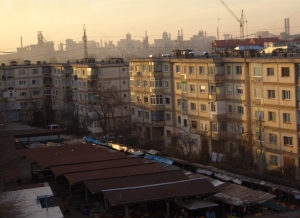
Perhaps the most enduring symbol of the Soviet experiment is their architecture. During the spring of 2007, I lived in an oft-forgotten corner of Romania, working to expand
HOPE’s work into the country. As with all former Soviet republics, Romania’s cities are filled with massive apartment blocks, exemplified in this picture which was taken from the window of the apartment where I lived.
Romanian Apartment Block
They aren’t pretty. These concrete, gray monstrosities line every street, each one in a different state of disrepair. Not only do they blight these communities, but it also made navigating Romanian cities a nightmare (try finding your apartment when all the buildings are carbon-copies of one another).
The shared common space of the buildings was disastrous. The façade, lobbies, and stairwells –the commons–were always in terrible condition. The interesting thing about these buildings was that once you reached the door of the apartments, the “home” began. Inside, many of the apartments were actually quite nice, though you’d never know it from the outside.
The Communist regime built these concrete palaces but did a poor job (read: terrible) of maintaining them. Individuals buy the apartments within the building, but not the building itself. As a result, nobody maintains the lobbies, the landscaping or the exterior walls. Individual apartment owners simply fend for themselves, meaning the majority of urban Romanians live in ugly housing. The Romanian government proved time-and-again that it was a terrible landlord.
Under Communist systems, the government serves owns the real estate. The
tragedy of the commons is just one of a litany of Communism’s fatal flaws. We see glimpses of this economics reality every day in simple things like the way we drive rental cars (versus our own cars) and in the condition of dormitory bathrooms. Successful economic systems take the tragedy of the commons seriously, acknowledging that when “everyone owns it, nobody does.”
