My wife and I often visit our friends in Breckenridge, Colorado. We love the beauty of the mountains and enjoy our friends immensely. Their 8-year old son, Nathan, is a terrific source of entertainment. During a recent dinner conversation, Nathan informed us about his Little League baseball season. He rattled off the scores of his team’s last few games. His parents quickly stopped him, interjecting that the league and coaches don’t actually keep track of scores.
Nathan retorted, “We all keep score anyway. We always keep score.”
I smiled, thinking back to my own youth baseball experience when I did the exact same thing. Sure there were no scoreboards, but every single kid on the diamond knew the score. Why? Because we want to know how we’re doing. It’s more than just winning and losing. We want a tangible measure of our performance. Are we succeeding? Are we catching up? How bad is it? Keeping score answers those questions.
In working with the poor, many times it’s easy to justify not keeping score. After all, we’re trying to help people. Isn’t that enough? I’m not sure it is. I think we need to keep score. It’s not about knowing if we’re winning. Even if the score illuminates we are losing, at least we have a gauge of how we’re doing.
It is particularly challenging to measure spiritual impact. At HOPE, it is straightforward to track financial metrics. We measure repayment rates, savings balances, client retention and a slew of other data points. It is much more challenging to gauge whether our work impacts the spiritual climate of the communities and families we serve. It’s hard and it’s also controversial to suggest we can measure spiritual impact when we know that only God sees the heart.
This month, a conference with a bold title—Spiritual Metrics—is gathering to discuss these issues. I believe it is possible and critical that we measure our spiritual impact. While we can only “see in a mirror dimly,” dimly is better than not at all.
We aren’t perfect in our measurement, but at least we know how many clients have been given a copy of God’s word, how consistently our staff gathers for devotions, and how many churches we actively partner with. It takes creativity, but per the old management axiom, what gets measured gets done. We need to keep score to remain accountable to what we are uniquely positioned to do as Christian organizations. Just like Nathan’s baseball team, we need to keep score.
Lush vegetation creeps onto the roads wherever it’s permitted to do so. Tired political posters adorn the street signs, interrupting the brightly-painted buildings which line the crowded streetscape. Our bus darts through the tight thoroughfares in San Pedro, avoiding overtaxed motorcycles with nearly impossible precision. The streets teem with Dominican culture: Venders peddling just-picked-from-the-field sugarcane, scads of Chihuahuas scampering behind their owners and uniformed school kids winding through the bustle toward their classrooms.
I like it here. There is richness in the culture and authenticity in the people. My work has been the impetus for my recent travels here. Traveling with groups of HOPE donors, we visit the courageous Dominican entrepreneurs we serve throughout the country. Each trip looks different. The donors, entrepreneurs, and communities we visit are unique. I see new places and experience fresh stories. There is one theme, however, which connects all these trips. I’m not proud of it, but I’ve committed one regrettable act on every trip I’ve taken here, an act I’ve only recently even identified.
While navigating through the DR, we always stumble upon a sad neighborhood. These communities, normally labeled shanty towns, usually border sugarcane plantations and they reflect a much cloudier image of the spirited Caribbean culture. Like a dandelion-rich lawn on a well-manicured suburban street, these poor communities stick out. The evident material poverty is jarring. And it’s in these places—on every trip—where it happens: I slip out my camera and capture the misery. I find an especially forlorn-looking mom or a cobbled-together home (preferably both) and snap away.
These snapshots, illuminating the most desperate scenes I can find, become like trip trophies. They’re the type of pictures which make me feel guilty about complaining. About anything. They remind me of how nice my house is and how full my closets are and of just how very much I have. The pictures hold just a glimmer of redemptive value in this convicting power. But, when I snap these candids, I define those communities by what they lack. With each flicker of my camera lens, I make one more strike against those places, stamping them by their deficiencies.
Our charity is often the same. When given the option between defining people by what they have or by what they lack, we normally choose the latter. It’s easier to meet needs than it is to unlock potential. It’s quicker to heal wounds than to train doctors. It’s simpler to raise money to give stuff than for training to make stuff. But, I know I’d sure rather be known for what I do well than by what I lack. The LORD your God is in your midst,
a mighty one who will save;
he will rejoice over you with gladness;
he will quiet you by his love;
he will exult over you with loud singing.
(Zephaniah 3:17 ESV)
I’m thrilled to serve a God who truly knows me. A God who does not define me by my weaknesses. A Creator who made me in his image. A Father who “exults” over me, his child. These truths convince me that If God and I sojourned across the Dominican together, his pictures would look strikingly different than mine.
It was a moment when personal convenience trumped common decency. Desmond, our six month old, was in his cheery post-feeding bliss. And, as I moved him through our hotel room, Desmond performed a response not uncommon for full babies: He spit-up. And the carpet caught the brunt of his act.
It was in this moment where I miserably failed a test of honor. I simply and soullessly watched as the spit-up pooled on the hotel’s beautiful carpet. Without any ethical reservations, I smushed the spit-up into the carpet fibers with the sole of my shoe. With just a few spineless swipes, Desmond’s deposit disappeared. I can’t even pretend I waffled with the decision. The whole sequence lasted just seconds.
Since that regrettable moment, I have attempted to identify what motivated me to do it. Despite its incivility, there have to be at least meager grounds for what I did. This is what I know: I would never have done that in my own house. In fact, I recounted a number of home floor-scrubbing memories, moments where I busted out specialized cleaning products and bristle brushes to clean even minor blemishes, exhausting my arm and back muscles in the process.
Ownership was the difference between these Mr. Clean moments and the hotel room villainousness. I am deeply committed to maintaining my home. It’s a place where I have invested personal energy, money and time. The hotel room, however, was just rented space. I knew I would never see that room again, so I was unconcerned about the long-term cleanliness and vibrancy of the hotel’s carpet.
While I am deserving of scorn, don’t furrow your brow at me just yet. You’re no different from me. I’m betting you’ve Andretti’d more than one Hertz rental in your lifetime. Or, perhaps you’ve left a bathroom stall in a condition which your mother would not approve. The principle applies beyond carpet stains. It’s the reason dormitory bathrooms teem with innumerable bacterial varieties. It’s why my fellow Coloradans feel no shame in abusing their rental skis while shredding the mountain. It’s why old Soviet apartment buildings look worse with each passing month.
At HOPE, we are committed to not dictating to our entrepreneurs the type of businesses they should start and run. We avoid coaching them into specific ideas for the same reason I vigorously scrub our home’s soiled carpets. If we conceive it, they don’t own it. Business challenges become as dismissible as hotel room infractions. When our clients pursue their own dreams, no stain—a rough sales month or tough weather—is uncleanable.
TOMS Shoes defines cool. These hip slip-ons are the garnishment of urban hipsters, but even much-less-cool folks like me love when companies give back. The winning equation for TOMS has been the “buy one get one” approach they pioneered: You buy slick kicks…and poor kids get free shoes. This equation has propelled TOMS to corporate superstar status.
All companies practice and celebrate their do-goodism. There’s even a cumbersome title for it–corporate social responsibility (CSR). Analyzing corporate charity models is one of my hobbies. Today’s doing good battle is between TOMS Shoes, the hipster heavyweight, and Whole Foods Market, the granola momma’s utopia.
VS.
—-
TOMS: Lots of good, but some areas that could be tweaked. Please: Don’t chuck your TOMS at me just yet. Hear me out. The good: They connect their product–shoes–to their charity–shoes for poor kids. Rather than supporting something entirely unrelated, like well-drilling in Africa (leave well-drilling to Aquafina and Dasani), TOMS’ charitable endeavors are a foot-in-shoe fit, you might say, with their business. Needs Improvement: First, though fabulously intended, I’m in the choir of skeptics about the impact of distributing free shoes to poor kids. In short, giving away free stuff, whether its TOMS Shoes, school supplies, or castaway Super Bowl t-shirts, almost always has a negative long-term impact on local economies.
Second, their social mission is sold as an add-on to their business. Like many other companies, they slice off a share of revenue and use that to fund charity. Giving is a good thing, don’t get me wrong, but companies like TOMS celebrate the toppings rather than the sundae itself. They splash a “charity cherry” on top of their business, but often neglect to acknowledge the core contribution they make to society: Providing meaningful jobs and cool shoes to our world. Whole Foods Market: Though much more nuanced than TOMS, their approach to doing good is “best in class.” The good: On a recent trip to Whole Foods to buy a bouquet of flowers for Alli, I left deeply impressed with the way their charitable efforts are woven into their core business: Selling healthy, fresh groceries. Rather than highlight their food donations, or the food relief agencies they could financially support, they celebrate the livelihoods they support across the globe and the nutritious goods they provide to their customers. I got this simple flyer with my flower purchase featuring Alfredo, one of the farmers:
Let’s be clear: Whole Foods profits from my purchase. They are not motivated to work with Alfredo solely because they want to help the vulnerable. They work with Alfredo because he grows gorgeous flowers and enables shareholders to earn big returns.
Still, they do business with Alfredo in a redemptive, equitable way, shedding light on the real people–the breeders, bakers and butchers–who produce their groceries. Like Whole Foods, Starbucks shines as a kindred spirit in the way they treat and celebrate their 75,000 coffee farmers. The verdict: Like TOMS, Whole Foods gives a percentage of their revenue to provide additional support to farmers like Alfredo, but that becomes cursory, their add-on, to the livelihoods they support. Rather than voicing poetic kudos to their corporate tithing, Whole Foods highlights the inherent and more significant value their business brings to our globe. The clear winner? Whole Foods. They do good well.
There is a subtle, but at times blatant, message which has flowed from the pulpits and lecterns in our churches and universities. The message is this: Our world is increasingly poor, accelerated primarily by the rise of global capitalism and its chief culprit, “big business.”
An anthology of leading Christian thinkers described capitalist economies as a tyranny. The authors went further to indict capitalist economies as wholly “antithetical to the gospel.” One of the contributors, Marcelo Vargas, did not guise his critique:
In the beginning, [it] appeared to be a blessing, but it is a blessing that has been transformed into a curse.
It is really easy to throw stones at capitalism. Vargas and others cite stories of ruthless sweat shops, unbridled consumerism, Ponzi schemes, extreme income inequality, and gluttonous Wall Street executives. There are undeniable flaws, abuses and inequalities within our current economic system. However, if you are at all concerned about the poor; then this system is absolutely the best one we’ve got.
In spite of its flaws, many of which are heinous, the increasingly connected global marketplace is undeniably the best broken system–and its positive impact on the lives of the poor far exceed any system we have seen in our world’s history. The problem with many of the sweeping condemnations of capitalism is that they castigate capitalism based on its villains rather than by its record.
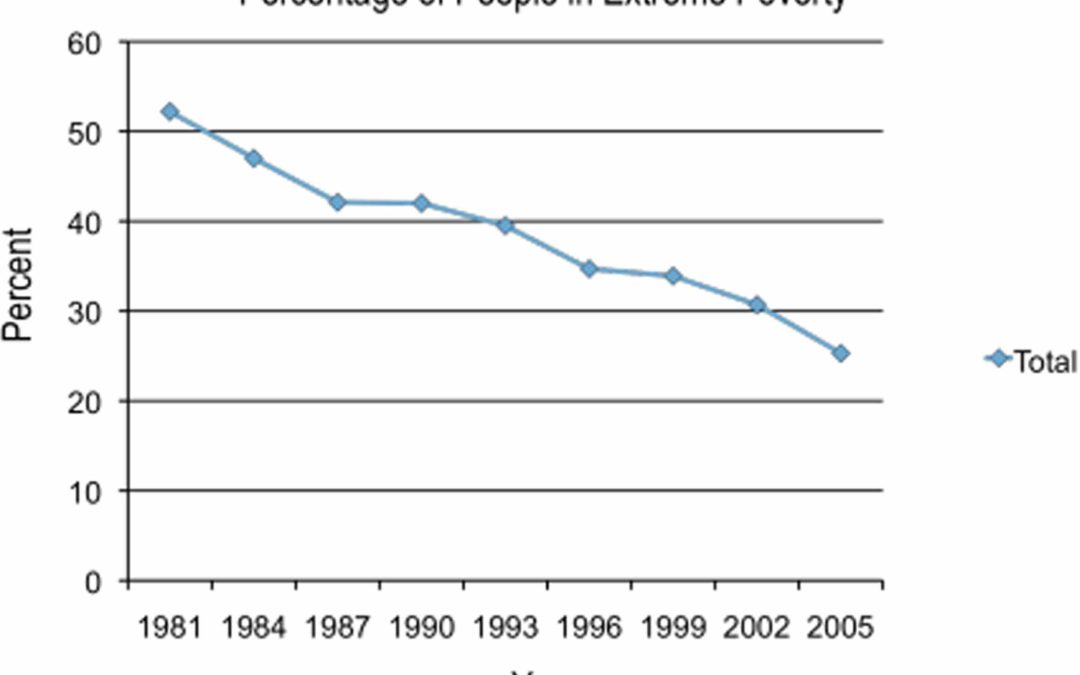
The most critical measure of success, a literal “life or death” statistic, is one that examines whether the world’s most vulnerable have escaped extreme poverty. To that point, and contrary to what many of the its loudest critics proclaim, extreme global poverty has been cut in half over the past 25 years and opportunities for the poor to progress have grown exponentially.
Source: 2009 World Development Indicators, World Bank
In a recent theology conference at Wheaton College, theologians Dr. Brian Walsh & Dr. Sylvia Keesmat described capitalism as “crucifixion economics” and went on to say that “Greater prosperity for [the United States] or its rich neighbors…will not and cannot result in a more peaceful planet.” They slammed global markets and encouraged Christians to withdraw, suggesting that when the rich get the richer, the poor will surely get poorer. I guess my question is this: Just who is being crucified in our current global system? Over 1.4 billion people have escaped extreme poverty over the past 25 years.
Global capitalism has provided unprecedented opportunities for innovative economic development and transformative missions. Tens of millions of families have escaped extreme poverty on its back. Professor, Hans Rosling, statistician extraordinaire, articulates this progress beautifully in this four minute clip–illuminating that by every measure (child mortality, life expectancy, etc.), enormous progress has been made.
On the flip side, Rosling’s data highlights that the poor in the countries which have chosen to practice an anti-capitalist economic models (e.g., North Korea, Cuba) have not fared as well as they have in capitalist and pseudo-capitalist (e.g., China) economies. Even Fidel Castro admitted the failure of his system just two months ago, when he said, “The Cuban model doesn’t even work for us anymore.” The poor in emerging capitalist economies like Rwanda and India have a different story to tell, as millions have bootstrapped their way out of extreme poverty.
Collectively, we have two options: We can vilify capitalism till the end of days, or, we can be citizens of redemption–salt and light–bringing healing to the brokenness which exists in our current broken system while also being honest about its incredible successes. We can start and run “best of class” global businesses, provide entrepreneurial opportunities to the poor, invest in businesses which do things right, and give generously to the vulnerable. This is the message which should resound from our pulpits and lecterns.