by Chris Horst | Mar 15, 2009 | Blog |
As a tribute to the late Paul Harvey, who passed away last month, I’d like to share “the rest of the story” of HOPE’s beginnings. You think you know how HOPE International began? Yes, the Ukrainian pastors approached Jeff Rutt (HOPE’s founder) and his church and asked them to stop with the hand-outs. And yes, HOPE began with twelve enthusiastic Ukrainian entrepreneurs shortly thereafter. But, do you know what happened in-between those two incidents? The story is actually a bit grittier than what gets printed in the brochures.
As HOPE’s web site history correctly states, Jeff “returned from the trip with a strong drive to find a solution. He plunged into research and eventually discovered the concept of microfinance.” “Eventually” is the key word. When the Ukrainian pastors approached Jeff in 1997 and asked him and his church to change their missions strategy, Jeff started thinking. What these pastors asked for was a long-term, sustainable solution to the abject poverty which existed in their communities.
Jeff and his church thought through and researched close to 50 different ideas and eventually landed on a promising plan. The plan they decided on was to help these churches process and sell sunflower seeds, as sunflower seeds are one of the most abundant resources in Ukraine. They wrote a comprehensive business plan and then raised $2,000 to buy a top-of-the-line sunflower seed processor. Through this plan, Jeff estimated the Ukrainian church members would be able to generate thousands of dollars to fund the ministry of the church, eliminating the need for his church to bring the hand-outs.
They excitedly took care of all the shipping and logistical issues to ensure it got to Ukraine. Jeff led a group of enthusiastic members from his church to Ukraine to be there for the delivery of the machine and to help train the Ukrainians on how to use it. They celebrated the machine’s arrival, took their pictures arm-in-arm with their Ukrainian friends, and flew back home—solution found!
Not exactly… One year later, when Jeff and the church returned, they found the machine exactly where they had left it. The Ukrainian church leaders were embarrassed to even show them the unused machine. “There was absolutely no evidence it had been used…it was in the exact same spot we had put it,” Jeff shared with me. Cobwebs and dust littered the gears and levers. Remarkably, the processor hadn’t moved an inch from where it had been delivered. It hadn’t even been turned on.
Why did this happen? The issue, as Jeff describes, was ownership. “It wasn’t their idea. It was our idea. When you have your own idea, then you will do whatever it takes to try and make that idea work, but they didn’t have any ownership of this idea.” Ownership is the name of the game. Often, charity, while well-intentioned, fails to truly stimulate long-term change. Even in the case of providing an income-generating piece of machinery, Jeff found that without local ownership, the idea and machine wasn’t ultimately theirs.
We need to continue to find creative ways to partner and empower the poor, to break the perpetuity of poverty. Real transformation and development happens when we partner with local ingenuity and ideas. Jeff and his church learned that lesson in a very real way—and HOPE was birthed out of that realization. And now, today, in some of the most challenging communities in the world, hundreds of thousands of industrious and innovative individuals are having their potential, dreams and ideas awakened and resourced. In the words of Paul Harvey, “And now you know…the rest of the story.”
(Chris)
by Chris Horst | Feb 15, 2009 | Blog |
Let the thief no longer steal, but rather let him labor, doing honest work with his own hands, so that he may have something to share with anyone in need. Ephesians 4:28 (emphasis mine)
“So that.” Our mandate, as believers, is to equip and empower others to not just leave their old lifestyles, but to be transformed themselves so that they can help others. What I love about this verse is that our mandate doesn’t stop with helping thieves stop stealing. Our calling is not solely to help the poor to no longer be poor. We’re called to help them become agents of change in their own communities so that as a result of our help, they can then help others. How can the church respond to this mandate?
On the island of Hispaniola, tens of thousands of Haitian immigrants have migrated across the border into the Dominican Republic in search of a better life. Haiti is the poorest country in the Western Hemisphere and often the prospects of moving into the Dominican Republic, while still a very poor country, are enticing. However, the reality is that the dream of a prosperous new life rarely comes to fruition. Unable to find honest work, many Haitian immigrant mothers resort to prostitution as the cries of their hungry children become too much for them to bear.
The churches in the Dominican Republic want to help. They want to help these mothers leave that destructive lifestyle. But how? No amount of prayer, food, medical treatment, clothing giveaways, water sanitation, or even advocacy is going to free them. The issue is employment. These women’s children are dying in front of them and they need money to feed them and put them in school. Churches there want to help these women, to live out Eph. 4:29, but they don’t know how.
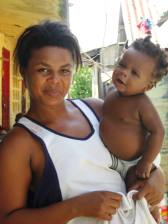
One of these prostitutes is named Rosa Andre (pictured with her son below). Rosa is HIV+ and has five children. Iglecia Buen Samaritano (Good Samaritan Church), in Puerto Plata, DR, wanted to minister to her and women like her, but did not know how. Last year, in partnership with HOPE, Iglecia Buen Samaritano pioneered a new program to help women like Rosa. Over the course of 40 days, church volunteers and HOPE employees met with a group of 20 prostitutes, including Rosa, every day to go through biblically-based business training and through Rick Warren’s book, The Purpose Driven Life.
Many of these women learned for the first time that there is a God who loves them and has a purpose for them. At the end of these 40 days of training and encouragement, they were each given a loan of about $150 to start a business. The results have been astounding. Many of these women have entered into a relationship with Christ and over 95% of the women who have gone through the program have not gone back to their old occupation as they are now able to provide for their families through honest work. They’ve seen real change happen in their lives. We are now replicating the program throughout the country because of the success in Puerto Plata.
Rosa, when asked about the impact of the program on her life said this, “There is a change because before I went out and engaged in prostitution. I feel safer now because I don’t go out. And now I can support my five children by selling clothes. I knew about the love of God before but I didn’t understand it. I understand that God loves me now.” The church found a way to help Rosa. They responded to Ephesians 4:28. Rosa no longer is selling her body for sex, but selling clothing so that she can provide for her five sweet children.
Let the prostitute no longer sell her body for sex, but rather let her labor, doing honest work with her own hands, so that she may have something to share with anyone in need. Ephesians 4:28 (revised)
by Chris Horst | Jan 15, 2009 | Blog |
Matthew Parris, an award-winning columnist with a prominent British newspaper, wrote this in a recent column:
Travelling in Malawi refreshed another belief, too: One I’ve been trying to banish all my life, but an observation I’ve been unable to avoid since my African childhood. It confounds my ideological beliefs, stubbornly refuses to fit my world view, and has embarrassed my growing belief that there is no God.
Now a confirmed atheist, I’ve become convinced of the enormous contribution that Christian evangelism makes in Africa: sharply distinct from the work of secular NGOs, government projects and international aid efforts. These alone will not do. Education and training alone will not do. In Africa Christianity changes people’s hearts. It brings a spiritual transformation. The rebirth is real. The change is good. (emphasis mine)
What a powerful proposition Parris suggests. I agree with him strongly, as does my organization, HOPE International. We believe his comments are the reason Christ-centered organizations are so important in Africa. Still, it is confounding to read this from an atheist. Essentially, what Parris says compares to Mitt Romney making a comment like this in a primary debate: “You know, I believe I’m a great candidate, but I just think Rick Perry is better prepared and will be more effective than me at bringing about the type of change we need in America.”
It’s laughable to think about. Yet, this is what Parris says. Despite that he whole-heartedly believes there is no God, he supports and believes in the work of Christian organizations in Africa because of the transformation which only God can bring. We have seen this clearly demonstrated around the globe. The transformative message of Christ coupled with an effective and empowering method of helping is a dynamic combination.
As a decidedly Christian organization, we are actually able to add tremendous value to the lives of our clients because of our Christian-ness. And Parris, an atheist, seems to agree. In other words, HOPE is not just a Christianized knock-off version of bigger secular organizations. HOPE’s faith-based approach is much more than that – it’s ultimately the singularly most-important characteristic of our work.
