by Chris Horst | Dec 22, 2009 | Blog |
This is part two of a three-part series, “How Then Shall We Help?”
Last month I stated that decreased suffering does not necessarily follow increased prosperity. In many cases, increased prosperity simply leads to new kinds of suffering. Helping our neighbors materially is not enough. It would be easy to assume from those reflections that the answer to the question, “How then shall we help?” would be this: Plant churches, hold evangelistic crusades, distribute Bibles, and get people saved. As Jesus said, “For what will it profit a man if he gains the whole world and forfeits his soul?” (Matt 16:26) Why, then, does HOPE waste its time doing economic development when it could be focusing solely on the real work of preaching the Good News? The core issue here is whether our efforts should focus unilaterally on the spiritual condition of humanity.
The truth is this: We cannot ignore our clear call to generously give to the poor—and not just because it amplifies our words. Throughout Scripture (over 2,000 biblical passages) we are called to help the poor in tangible, material ways. Humans are not simply spiritual beings which happen to exist in a physical state. The needs of the present must be met while we seek to address the needs of the eternal. Why?
- The Bible says our faith is void without it. “If a brother or sister is poorly clothed and lacking in daily food, and one of you says to them, “Go in peace, be warmed and filled,” without giving them the things needed for the body, what good is that?” – James (James 2). Viewing compassion and justice as a “means to an end” (to get people saved) illustrates a troubling disconnect between body and soul. Our concern for the poor should be a natural and generous outpouring of our hearts, which have been transformed by Christ. As James said, if we ignore suffering, of all types, in our communities here and abroad, even if we share an encouraging word, “What good is that?”
- The historical Christian Church has embodied it.”Nothing has contributed to the progress of the superstition of the Christians as their charity to strangers…they provide not only for their own poor, but for ours as well.” –Julian. As the anti-Christian leader of the Roman Empire, Julian made this comment in 360 A.D. History indicates that the early Church saw people as more than spiritual beings. It was that radical generosity which provided fuel to the message of Christ. Early Christians, it seems, as Tim Keller describes, “were promiscuous with their charity” and it showed in the Church’s rapid growth in that time.
- Jesus taught and practiced it. “Which of these three, do you think, proved to be a neighbor to the man who fell among the robbers?” – Jesus, in the Parable of the Good Samaritan. Jesus, as Creator and Almighty God, chose to come and live among us, the poor. His Incarnation alone speaks to His concern for more than just our souls. He came from heaven to live among us on earth. While on earth, he healed the sick, befriended street-dwellers and prostitutes, and cared for the poor. In response to Jesus’ question above, someone in the crowd answered, “The one who showed him mercy.” Jesus replied to him, and to us, “You go, and do likewise.”
There is a problem if we view our sole purpose as Christians to proclaim the Gospel verbally. It illustrates a severe disconnect if we overlook the physical, emotional and social condition of our neighbors in our attempts to introduce them to Jesus. Further, our acts of service must not be viewed as a “means to an end.” Certainly, radical generosity opens doors to proclaim the Gospel. But, the Good Samaritan was not heralded because his mercy led to a conversion. He was heralded because countercultural compassion is the only appropriate response from a person whose heart has been transformed by the love of Christ. Thankfully, this is not an either/or proposition.
Next month, final reflections in the series, “How Then Shall We Help?”

by Chris Horst | Dec 19, 2009 | Blog |
Two years ago I tasted my first batch of Whirley-Pop popcorn. Crisp, airy, fresh, natural–delicious. My life changed in profound ways that day. It’s hard to look back on what life was like when my only popcorn option was the buttery, artificially-flavored and salt-saturated “popcorn product” birthed out of a microwavable bag. It should have made sense to me a long time ago. Why should I expect a prepackaged handful of kernels coated in artificial butter and zapped by high frequency radio waves to produce a quality product?

I try not to beat myself up over the countless microwaved bags of popcorn I ate before my introduction (i.e., conversion) to Whirley Pop. Microwavable popcorn is convenient…and it doesn’t taste terrible. I guess, in a sense, my rocky popcorn past is comparable to my friends who are committed Cubs’ fans. They’ve never tasted the joy of being a Phillies fan so why should I expect them to understand how completely inferior their fanhood truly is? Allow yourself to savor this kernel of truth: Once you taste a fresh-made batch of stovetop popcorn, you will never, ever go back.
Reasons we love our Whirley Pop enough to spend the time to blog about it…it is:
- Delicious & healthy. To reiterate, this is the best popcorn you’ll eat. Your mouth and your digestive system will thank you.
- Inexpensive. Trust me, in the long run, it will save you money. The upfront popper costs (~$20-25) are satiated by the money you save by buying kernels in bulk. It essentially pays for itself.
- Customizable. Like kettle corn? No problem. Think popcorn’s better with cheddar? Done. Stressed because you need a show-stopping party mix? Let your Whirley Pop help.
- Fun for kids. We do this with our neighbor kids all the time. They love spinning the popper. Imagine having that “Christmas morning joy” every time you bust out the Whirley Pop.
- Hip. We’ve found people that see our Whirley Pop genuinely like us more. We often hear comments like, “Oh wow — you’re a Whirley Pop couple?” and, “You two really seem to be ‘living the dream.'” It’s true. We are.
(Chris)
————————————
For those that don’t know how it works, it’s a very simple process:
- Turn your stovetop burner on high.
- Add 1/2 cup popcorn kernels (yellow or white) and 1 Tbsp oil to your Whirley Pop.
- Put your Whirley Pop on the hot coils and spin till the popping subsides.
- Pour the hot, delicious morsels into a bowl of your choice and enjoy.
- Wipe out the Whirley Pop with a paper towel.
- Just like that…you’re done. Done making popcorn…and done with that microwavable stuff.
by Chris Horst | Dec 5, 2009 | Blog |
Three years ago I read a book by Robert Lupton which changed the way I think about helping the poor. In that book, he introduced the concept of the “dignity of exchange,” which is one of the primary lenses through which I now view compassion. Lupton suggests in this book that “people would far rather engage in legitimate exchange than be the object of another’s pity. There is something in one-way giving that erodes human dignity.” The Christmas season has reminded me again of why exchange matters.
Today, Mile High Ministries (which also runs Joshua Station) is hosting their 16th annual Christmas Store, which gives opportunities for low-income moms and dads in Denver to buy Christmas gifts for their children (at subsidized prices). Parents, as customers, are able to be providers for their children at Christmas. The real Christmas gift of this annual tradition, in my opinion, is given to these parents: Dignity. These parents are no longer needy recipients…they are bargain-hunters.
As a junior in high school, I joined with a group of my friends to purchase Christmas gifts for a low-income urban family in my hometown, Lancaster, Pennsylvania through a local urban ministry. We got the name of a family and a list of suggested gifts and we went to Walmart to pick up the items. After purchasing the items, we drove to to the house, which was in a low-income housing community in a rough section of town. The four of us, all exuberant Christian kids, then hauled the gifts from the car to the door, where we delivered them to the mother of the children, while the children looked on.
I think back to the experience often:
What would it have been like if I was one of those kids? …to see my mom receiving my future Christmas gifts from a bunch of youth I didn’t know?
How would I felt to be that mom or dad? …to have my neighbors see me receiving those gifts? …to feel as though I was incapable personally of giving my kids a great Christmas?
Compassion is important. But compassion, without thoughtful and prayerful consideration of the consequences of the actions, can be harmful. Most mothers will do whatever they need to do to provide for their kids, even if that means they have to humble themselves to allow wealthy high-school aged kids to pick up the tab for Christmas. One gift which we did not give to that mother was dignity. I am excited that Mile High Ministries, and many other wonderful organizations, have re-examined their Christmas efforts to support low-income families.
Jeff Johnsen, Executive Director at Mile High Ministries, said this as to why they began operating the Christmas Store 16 years ago. “A lot of us at Mile High Ministries saw over and over again that there was a hidden price being paid by some of the families that were served [through their traditional Christmas giveaways]. You could see it in a dad’s face. These generous gifts were also a reminder to him that he couldn’t provide for his family that year.I decided there had to be a better way…Dignity is perhaps The Christmas Store’s chief product.”

by Chris Horst | Nov 21, 2009 | Blog |
 Dear Davey,
Welcome to the family. This new baby thing does not get old. We’re delighted to have you join us. And since your sister’s delighted-ness is by far cuter than ours, here’s a picture representing just how thrilled we are:

Someday you’ll have to let us know if we’re right, but we’re calling for a conspiracy theory. There’s just no way that you and your mom could be that cute only one hour after you’ve been born. Something is going on, because after seeing you/Chrissy and Graham/Kendal we’re convinced that someone’s doing some baby growing elsewhere.
We’re glad to see you confidently pull off your own unique style this early in life. Although the faux hawk have normally adorned urbanite males, you really brought something new to the style. And we agree, baby faux hawks should be the next thing. You clearly proved that it’s unbelievably cute.

Finally, we want to thank you. Thank you for making us feel like baby pros. Somehow, no matter how awkwardly we may be holding you, you mold to the position. And whenever we try to comfort you it always works, like what we’re doing was the exact thing you were asking for. Maybe you’re just trying to be nice, but we really appreciate it. You’ve been a tremendous boost to our self-esteem.
We love you, Davey Baby.
Aunt Alli and Uncle C

by Chris Horst | Nov 17, 2009 | Blog |
This is part one of a three-part series, “How Then Shall We Help?”
“It was an amazing mission trip. I can’t tell you how happy and content all the people were despite how little they had.”
Have you heard comments like this before? Have you said this before? I have said it several times. It’s a recurrent reflection after trips to poor countries because it is compelling to see joy in the faces of children, parents and grandparents despite their modest means. I specifically remember a joyful little boy from my last trip to the Dominican Republic who was running around wearing nothing but a ratty, tattered t-shirt. His face was dirty, he had few possessions, but, in the midst, he was content.
I have been thinking a lot about this the past few months. Christians in this country, I think, recognize we are called to help the poor. Biblically, there is almost no book in scripture devoid of God’s commands to care for the less fortunate. And, even in our secular culture, it is in vogue to care about “social justice.” It is hip to care about Africa and to buy fair trade coffee. My concern is in the outcome of this groundswell of excitement in “giving back.” I believe the end-game for Christians, often, is supporting any program, project or initiative which increases the prosperity of the poor.
The line of reasoning goes like this: Increased prosperity leads to decreased suffering.
At first glance, I agree with this statement. There are poor people in this world. As Christians, we are called to help them out. We help them by providing education, medical care, housing, language training, business loans, savings accounts, and clean water—all to help them increase their prosperity. As a result, this line of reasoning states, their suffering decreases. Increased prosperity leads to decreased suffering, right?
What if, however, when we help those poor, happy, underprivileged families by providing them with things, they develop some of the same issues our over-privileged children have? Entitlement, jealousy, materialism, obesity, greed. What if, in our attempts to help, rather than decreasing it, suffering just takes on a new identity? I believe most American Christians would agree that increased financial prosperity does not lead to increased fulfillment. We do not have to look beyond our own families and friends to know that material wealth has very little influence on personal joy, satisfaction or success. But, it seems to me that reality has little bearing or influence on our attempts to help the poor.
Now, don’t get me wrong. I work for an organization which helps the poor. I absolutely believe we are to sacrificially serve and “give back” to those in our communities and to those around the world. But, just helping people increase their prosperity cannot be our end-game. In fact, helping the poor does not always decrease their suffering. Next month I will continue to explore these issues while grappling with the question: How then shall we help?

by Chris Horst | Nov 15, 2009 | Blog |
For the single mothers living at Joshua Station (all 25 families here currently are led by single moms), life has been characterized by broken promises. Fathers who swore they would always be there for the kids. Ex-husbands who claimed they would never hit them. Family members who somehow always forgot to pay back borrowed money. For these women, it is only safe to have low expectations.
It was in that context that our small group at church endeavored to plan an event for the women of Joshua Station which inverted that pattern. Exceeded expectations…instead of lowered. Fulfilled promises…instead of broken. Alli and I were thrilled when the plans started coming together and we truly took a backseat in the process as the generous and enthusiastic members of our group took the lead. They each brought their own creativity, energy and passions into the planning. After many discussions, we settled on doing a “Ladies Night Out,” featuring spa treatments, massage, desserts, live music and foot-washing.
St. Augustine ends one of his famous quotes by saying, “And in all things, charity.” From the beginning, our group’s unstated motto exclaimed, “And in all things, luxury.” Each member of our group found ways to ratchet it up a notch. Nothing was done cheaply, as if anything they could do was “good enough.” One group member asked her masseuse to volunteer for the event. Another member recognized a large percentage of the moms were Latina so she made culturally-sensitive desserts. And together the group hand-made neck-warmers, facial scrubs and foot baths. To top it off, the transportation for the evening was a stretch-SUV limousine.
By all accounts, the evening was a smashing success. The men in our group watched the herd of kids for the evening, allowing the moms to have a free night, and the women in our small group lavished the Joshua Station mothers with an evening fit for even the most elite women in the most prestigious country club. For at least one night, we wanted each of these women to know they were created for dignity by a God who knows and loves each one of them uniquely. For at least one night, they were the honored guests. For at least one night, they were given the very best.
In many ways, our goal was to reflect the love our Savior demonstrated in choosing, as omnipotent Creator, again and again, to lavish each of us with exceeding grace. And from the comments we heard from the guests, that message was clear. One of the mothers commented after the evening that “the hosts just kept surprising us.” Another wrote this in her heartfelt thank-you note:
It is inspirational and authentic to be shown true respect and “feel the love” one human to another in the manner you ladies demonstrated the other night.
The members of our small group communicated worth, honor and respect to these women who are all too accustomed to broken promises. It was beautiful to observe this extravagance on the margins.
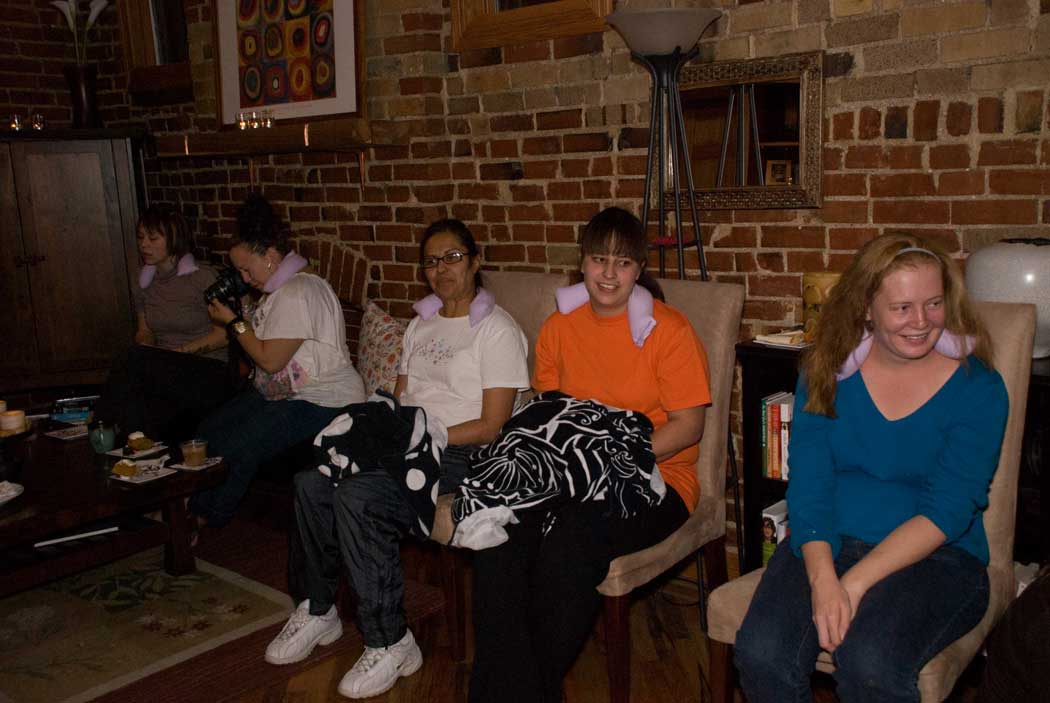

Thanks to our community group member & photographer, Elizabeth Strauss, for the photos.
(Chris)



