A few months ago I wrote a reflection on Steve Hill and Jim Howey, two friends who lead a metal fabrication business in Northeast Denver. That blog post grew into a full-fledged article that was published today on Christianity Today’s This is Our Cityproject. This is Our City is my favorite online destination. Last year they profiled another favorite business of mine, Bud’s Warehouse. Here’s the summary of the project:
A new generation of Christians believes God calls them to seek shalom in their cities. These Christians are using their gifts and energies in all sectors of public life—commerce, government, technology, the arts, media, and education—to bring systemic renewal to the cultural “upstream” and to bless their neighbors in the process. No longer on the sidelines of influence, emboldened by the belief that Jesus loves cities, they model a distinctly evangelical civic engagement for the 21st century.
This Is Our City, a multiyear project of Christianity Today, seeks to spotlight in reporting, essays, and documentary video how these Christians are responding to their cities’ particular challenges with excellence, biblical faith, and hope. The six cities we are profiling differ dramatically from one another in size, economic climate, ethnic and racial composition, and in their history of Christian presence, leadership or abdication, at crucial moments. But they all have stories worth telling. Wherever we live, we can learn something from these cities about faithfulness to our own place.
It’s the ordinary-ness of Jim and Steve’s business that is the very reason their story needs to be shared. Across our country, entrepreneurs like Jim and Steve add immense value to our society. Quite simply, they just do business the right way: They create jobs, treat their people well, and innovate valuable products and services for their customers. It’s profound work, even if the images of rivets, sheet metal and factories don’t necessarily sing.
Steve Hill & Jim Howey at Blender Products, Inc.
I write extensively about poverty on this blog. An article on metal fabricators almost feels like a distant relative to the poverty conversation. But I don’t see it that way. Steve and Jim aren’t just “business guys.” They are urban ministers, justice workers and artists. Heroic civil rights activist, John Perkins, once said, “Jobs are the world’s best social service program.”
Perkins was right. When we reimagine the entrepreneur, we realize that Jim and Steve’s work is hardly ordinary. It’s heroic. And that’s why I’m thrilled to share it.
There’s a simple reason why manual laborers are called “blue-collar”: The color blue, it turns out, hides dirt better than the white seen in office buildings. But “blue collar” defines more than work apparel, of course. It defines industry, even a way of life. And its stereotypes are often unflattering. But a metal products manufacturer in Colorado is working to undermine those stereotypes, right on the shop floor…
I sat on the countertop as my mom shared the tragic news: My grandpa—Abe Horst—had died. A heart attack seized his last breath at the early age of 63. While reading the newspaper during a summer day in 1997, he passed. He was healthy and active and we were not ready to say goodbye. While our relationship revolved around my early adolescent affinities like pizza and beach vacations, I cherished him immensely.
I have learned more about Abe in retrospect. And the more I uncover, the more I mourn. Candidly, the pain of losing him is stronger today than it was then. I’ve learned Grandpa was an entrepreneurial risk-taker and a gifted manager. I’ve discovered he grew his real estate development company from 25 employees to over 600. I’ve visited his expert craftsmanship displayed in the buildings he constructed across the Susquehanna Valley.
In an interview on his leadership approach, Grandpa shared a value he held dearly.
Our people are a joy and a blessing. Absolutely, I would say that is where our success begins. These are not just warm bodies. They are tradesmen and craftsmen who can work with their hands. They can visualize, see the picture of a finished job in their mind’s eye long before it’s completed. They’re proud of the work that they do and that shows in the work they do.
From the farm fields to construction sites to executive suites, Abe demonstrated a truth he believed: God created us to create. And he let his workers know it. At his memorial service, hundreds of past and present employees lined up out the doors to share their respects. The volume of compliments we received from these workers astonished us. I’ve learned my grandpa was known for creating abundant time—even when he was the CEO—to visit his workers and sincerely affirm their abilities.
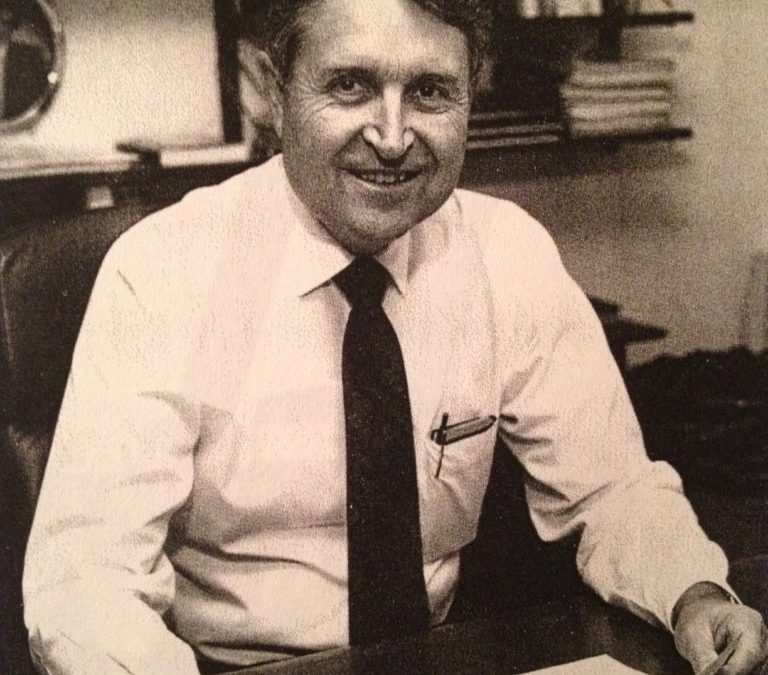
Abe Horst
Work isn’t popular. It’s our cultural scapegoat, vilified for many reasons. Most-recently, a New York Times writer, Tim Kreider, penned a mostly thoughtful column on busyness, but lamented a widely held falsity.
The Puritans turned work into a virtue, evidently forgetting that God invented it as a punishment.
When we examine our culture’s caricatures of work, it sure seems like work is cursed. We suffer through the “daily grind” because we’re “working for the weekend.” After all, “it’s five o’clock somewhere.” In our Office Space culture where companies like Dunder Mifflin are normalized, it’s easy to believe work is inherently flawed. In God’s design, though, people weren’t strumming harps on angelic clouds. The Garden of Eden wasn’t a Sandals Resort. In Eden, we see Adam and Eve meaningfully employed to tend their property. The first action God took and command he gave was to work.
Nearly all the biblical heroes of the faith practiced a philosophy of vocation that was redemptive, not resentful. Joseph’s career began in the sheep pastures and ended in the Egyptian Oval Office. Lydia designed clothing. Jesus knew his way around a woodshop. Throughout scripture, we see workers modeling creativity, diligence and purpose.
My grandfather understood this and instilled it in those around him. When Christians allow cultural stereotypes to become our narrative, we ask the wrong questions: How long till Friday? Why can’t every day be a vacation day? In a stirring Labor Day editorial, Rev. Bill Haley suggests we consider work differently:
“How is my job creating good in the world? or “How is my job helping fix what is broken in the world?”
Kreider suggests work is cursed so we should do less of it. Grandpa believed work is challenging and it’s good for us. Work isn’t an evil to be escaped. My friends who are unemployed, underemployed or retired-without-purpose all attest: It’s miserable. Work is cursed only when we relegate it to its stereotypes. Hundreds of workers came to Abe’s funeral not because he gave generous vacation time, but because my grandfather understood God intended work as a gift to embrace, not a curse to escape.
There are few people less qualified to speak at a Princeton University conference in Austria than me. Even prestigious universities make mistakes, however, and they certainly did by sending me an invitation. In the pre-conference packet, lofty bios filled whole pages. It became strikingly evident that my title looked akin to a computer programmer at a bodybuilding convention. My bio followed a former US ambassador’s. But sure, I wasn’t intimidated in the least to put my bachelor’s degree in sport management and 2.5 years of professional experience to work. The Woodrow Wilson School of Public and International Affairs at Princeton University (or TWWSOPAIAAPU for short) hosted the conference on the topic, “Faith and International Development.”They convened leaders from international organizations (like mine) as well as policy-makers and academics. We hailed from many faith and non-faith persuasions and enjoyed a week of Austrian culture together. And we debated amicably. There was only one guy there who rankled me. And he also happened to be the only other representative of a Christian faith-based organization.
His offered an irksome commentary on a subject I care about deeply. The crux of his message? Christian evangelism is dangerous, paternalistic and wildly inappropriate. He argued the sanctuary is the only venue where Jesus-talk is permissible, castigating international organizations with the audacity to claim otherwise. And I couldn’t disagree more. To this guy and those who think like him, evangelism (or, as he labeled it, proselytism) encroaches on modern sensibilities. Talking publicly about faith, he stated, is wrong. And he’s not alone. His views resound through the chambers of the elite and educated. Together, they dance to the inclusive harmonies of tolerance and diversity.
But my comrade fell into the very trap he lectured us to avoid. He advocated we sanitize our religious views from our work and lives. He reasoned matters of faith are personal, not public, and demanded we keep our religious opinions to ourselves. But all the while, he wasn’t offering some impartial perspective. He wasn’t living above the spiritual fray. He advocated for neutered convictions …as if he held no convictions at all?
Skeptics believe that any exclusive claims to a superior knowledge of spiritual reality cannot be true. But this objection is itself a religious belief…It is no more narrow to claim that one religion is right than to claim that one way to think about all religions (namely that all are equal) is right. – Tim Keller, Senior Pastor, Redeemer Presbyterian Church
I believe in civility and playing nice. This isn’t about ramming faith down throats or threatening fire-and-brimstone. I’m fighting for honesty. When we demand faith be bleached-out from our work, we commit the sin we scold against. My conference colleague tossed grenades at proselytism while attempting to convert me to his position.
[Proselytism] is virtually unavoidable: Almost everyone is a proselytizer on behalf of something… It may be possible for those almost or entirely without connection to others (hermits, those at the far end of autism or Alzheimer’s, long-term coma patients, and so on) to avoid proselytism completely; but otherwise we are all proselytizers. – Paul Griffiths, professor of Catholic Studies at the University of Illinois
I’m grateful my conference peer held such passionate positions. I will advocate for his right to share them. But it is self-defeating to demand some impossible form of sanitized society that inhibits religious discussion, as if the common man might somehow be duped into conversion. I believe in the life and promises of Jesus of Nazareth. And our world suffers if anti-evangelism evangelizers stifle me from sharing it.
I started a blog post about Chick-fil-A, but quickly realized that many smarter people have penned all that needs to be said on this issue. So instead, I’ve hand-selected a few interesting voices from diverse political and religious perspectives (Read: Opposite ends of the spectrum). Don’t thank me; it’s my pleasure.
Sarah Pulliam Bailey (online editor at Christianity Today) on how the Internet and journalistic sloppiness can fuel unnewsworthy stories:
People on the Internet are just discovering that Chick-fil-A, which is closed on Sundays, is a Christian-run business with a Christian owner who believes in traditional Christian doctrines. People of the Internet (at least the ones who drive traffic) are shocked! Shocked, I tell you. And I’m shocked that they’re shocked, so it’s shocking all around…Last week, I thought this controversy would blow over. Give it a day. It’ll go away. I felt like a little kid with his hands planted up against his ears while his divorcing parents were fighting. Please just stop and tell me when it’s over. But it doesn’t end. It keeps going. The media, desperate for clicks, blogs and writes and investigates and prods and reports and covers this very important lame story that we are just discovering already know.
Ross Douthat (New York Times columnist) on the religious liberty implications:
If you want to…ban Chick-fil-A in Boston, then don’t tell religious people that you respect our freedoms. Say what you really think: that the exercise of our religion threatens all that’s good and decent, and that you’re going to use the levers of power to bend us to your will.
Adam Schwartz (legal counsel for the ACLU) on the first amendment violations of mayors who threatened a Chick-fil-A ban:
If a government can silence an anti-gay business, the government can silence a pro-gay business.
The Economist on how a Chick-fil-A ban is well outside the legal bounds for a mayor or any other government official:
Expression is a right, and the local government can’t deny you approval to open your fast-food franchise because of your political opinions, any more than it can deny such approval because you’re Muslim, female or black.
Michael Bloomberg (New York City mayor) on the dangers of banning a business based on its ownership’s personal beliefs:
You can’t have a test for what the owners’ personal views are before you decide to give a permit to do something in the city. You really don’t want to ask political beliefs or religious beliefs before you issue a permit, that’s just not government’s job.
Adam Serwer (reporter with Mother Jones, a liberal political magazine) on protecting freedom of speech for even those we dislike:
The government blocking a business from opening based on the owner’s political views is a clear threat to everyone’s freedom of speech—being unpopular doesn’t mean you don’t have rights. It’s only by protecting the rights of those whose views we find odious that we can hope to secure them for ourselves.
Jonathan Merritt (author of A Faith of Our Own) on the silliness of not doing business with people you disagree with:
I don’t care how my dry cleaner votes. I just want to know if he/she can press my Oxfords without burning my sleeves. I find no compelling reason to treat sandwiches differently than shirts. From a business standpoint, some might say Cathy’s comments were imprudent if not downright dumb. But in a society that desperately needs healthy public dialogue, we must resist creating a culture where consumers sort through all their purchases (fast food and otherwise) for an underlying politics not even expressed in the nature of the product itself. If white meat’s not your thing, try the Golden Arches. But if you want a perfectly fried chicken sandwich, Chick-fil-A, will be happy to serve you — gay or straight. In this case, those who boycott are the ones missing out.
Denny Burk (professor of biblical studies at Boyce College) on the irony of the tolerance police:
You don’t even have to mention homosexuality or gay marriage. All you have to say is that you are pro-family, and certain municipalities will exile your business. Welcome to the brave new world of tolerance.
Ken Coleman (host of The Ken Coleman Show) on the need for civility amidst disagrement:
Increasingly, we see a well-oiled publicity machine that is redefining tolerance as, “either you agree with me or you need to button your lips.” Those who throw the labels of intolerance and bigotry at those who share an opposing opinion are ironically modeling a glaring lack of tolerance.
That mocha-frappacino is no longer just a drink and your chicken sandwich now signals your values. And once that game starts, then everything’s in play. The end result will be that moral judgment will happen easier and faster than ever, and always without the benefit of a hearing.
—-
We wrestle with how to be conscientious consumers. There is a fine line between condemning a company because it’s products, culture and practices display little redemptive value …and condemning a company whose leaders hold values that contrast strongly with my own. In that tension, here’s what I do know: The next time I’m at Chick-fil-A, I will order a #1 (sans pickles with BBQ sauce) with a Coke and a splash of hand-squeezed lemonade.
Finding a positive news story is a formidable task. Finding a positive news story about business is a nearly impossible task. Ponzi schemes, Hollywood’s corporate caricatures, and lavish executive bonuses define our perceptions. Examplars are one small we can all undercut the negative onslaught.
This story isn’t just inspiring–it’s personal. Mary Wolgemuth is my courageous and compassionate mother-in-law. Her survival story (as articulated by my father-in-law) reminds me that no job is just a job. And that no company just makes widgets. From the skilled chopper pilot who whisked Mary to her hospital to the medical engineers who designed the bolts that now hold her bones together. From the florists who arranged her hospital room bouquets to the gentle Southwest flight attendants that smoothed her path home to Denver. Bell Sports is just one player in the team of people who preserved Mary’s precious life during these arduous weeks: A beacon of entrepreneurial excellence.
—— An Open Letter to Bell Sports
Mary Wolgemuth has been my wife for over 34 years. We live in Colorado and we love to ride and hike together. On July 10, 2012 we were in Anacortes, Washington intending to do some riding with family for a few days. After roughly 25 miles of riding Mary lost her balance and fell into the path of a passing pickup truck. I was immediately behind her and witnessed her crashing to the pavement.
She was unconscious when I got to her. In ten minutes an ambulance arrived and shortly after that Mary was airlifted to Harborview Hospital in Seattle. Skilled doctors put her pelvis back together, while her fractured ribs and collarbone will have to heal on their own.
I firmly believe that God spared the life of my wife – but He used a Bell bike helmet to get the job done. The attached pictures show the compression in the area of the left temple of Mary’s helmet. She didn’t scrape on the ground but was pounded directly into the surface. It cracked her helmet in at least a couple of places… but it did what we needed it to do.
Mary’s Bell Helmet
I am deeply grateful to the Bell Helmet company for the protection provided to the head of my wife. You have given me my wife back, and I will be forever grateful. To the engineers who designed this, to the salespeople that got it placed at Performance Bike, and to the business people that helped to price this at a point where I could afford it… Thanks, a thousand times thanks.
God bless you and grant you much success in the days ahead.
Dan Wolgemuth
President/CEO, Youth for Christ USA
Timothy Kayera spoke with been-there-done-that confidence. He grew stronger with each word, pulling me closer with the fire of his conviction. And then he summarized everything I believe about charity. In four words.
I used to work with one of those organizations that gave stuff away to everyone. We’d give away animals, clothing and clean water. All for free. I remember when we’d give goats to people, I would get phone calls and they’d say, “Timothy, your goat is dead.”
Your goat is dead. I’ve tried to articulate this idea dozens of times over the years, but never this potently. In four words, the caller said:
It was never his goat in the first place,
It was inconsequential it died, and
It was Timothy’s job to replace it.
Kayera is a star in Rwanda’s promising cast of young leaders. He directs HOPE’s efforts in a region of Rwanda and he emphasized the difference of his new job. His work now creates dignity, not dependency. Partnership, not pity. Timothy joins a chorus of Rwandans in this song, from the president of the country to “Rwanda’s Desmond Tutu.”
[The poor] are as capable, as competent, as gifted, and as talented as anyone else…In society, you must create opportunities to help people develop their capacity and talents. – Paul Kagame
We need to move from aid to production, from existing to living. It’s high time we stop telling our people they can’t do it. They can, yes. And we shall do it. – Bishop John Ruchyahana
Timothy, President Kagame and Bishop Ruchyahana share this opinion: Traditional charity erodes the nature of people and the fabric of society. When giveaways permeate, they communicate a clear message: What you lack, I provide. Where you are weak, I am strong. When you can’t, I can.
It’s a bad message, preventing people from hearing the better message from their Creator: I made you to make. I designed you to design. You are blessed to bless others. When charity runs its course—as it has in many places in Rwanda, Haiti and elsewhere—it lures the poor with handouts and traps them on unneeded life support.
But that’s why Timothy got out of that business. He saw its destructive path and cut the cord before it strangled. Today he anchors his work on who people are created to be and what we are designed to do. He doesn’t lure with goodies. Instead, he demands hard work from those he serves. People like Rachel.
I saw the future of Rwanda in her. Rachel showed me the house she built and the 16 pigs she purchased over the past two years. She showed me the litters of piglets she’s bred and the piles of fertilizer she sells. But Rachel isn’t filling her barns for herself. I asked her what her dreams are and she said, “The greatest joy of these pigs is that I am now able to share with my church and with others.”
Rachel
Rachel didn’t beg for cash or stoop in compliance. She stood tall as a confident merchant, wife and mother. She did not avert her gaze. Her eyes were strong and generous. Rachel wasn’t the product of charity. She simply knew who she was created to be.