
by Chris Horst | Nov 17, 2009 | Blog |
This is part one of a three-part series, “How Then Shall We Help?”
“It was an amazing mission trip. I can’t tell you how happy and content all the people were despite how little they had.”
Have you heard comments like this before? Have you said this before? I have said it several times. It’s a recurrent reflection after trips to poor countries because it is compelling to see joy in the faces of children, parents and grandparents despite their modest means. I specifically remember a joyful little boy from my last trip to the Dominican Republic who was running around wearing nothing but a ratty, tattered t-shirt. His face was dirty, he had few possessions, but, in the midst, he was content.
I have been thinking a lot about this the past few months. Christians in this country, I think, recognize we are called to help the poor. Biblically, there is almost no book in scripture devoid of God’s commands to care for the less fortunate. And, even in our secular culture, it is in vogue to care about “social justice.” It is hip to care about Africa and to buy fair trade coffee. My concern is in the outcome of this groundswell of excitement in “giving back.” I believe the end-game for Christians, often, is supporting any program, project or initiative which increases the prosperity of the poor.
The line of reasoning goes like this: Increased prosperity leads to decreased suffering.
At first glance, I agree with this statement. There are poor people in this world. As Christians, we are called to help them out. We help them by providing education, medical care, housing, language training, business loans, savings accounts, and clean water—all to help them increase their prosperity. As a result, this line of reasoning states, their suffering decreases. Increased prosperity leads to decreased suffering, right?
What if, however, when we help those poor, happy, underprivileged families by providing them with things, they develop some of the same issues our over-privileged children have? Entitlement, jealousy, materialism, obesity, greed. What if, in our attempts to help, rather than decreasing it, suffering just takes on a new identity? I believe most American Christians would agree that increased financial prosperity does not lead to increased fulfillment. We do not have to look beyond our own families and friends to know that material wealth has very little influence on personal joy, satisfaction or success. But, it seems to me that reality has little bearing or influence on our attempts to help the poor.
Now, don’t get me wrong. I work for an organization which helps the poor. I absolutely believe we are to sacrificially serve and “give back” to those in our communities and to those around the world. But, just helping people increase their prosperity cannot be our end-game. In fact, helping the poor does not always decrease their suffering. Next month I will continue to explore these issues while grappling with the question: How then shall we help?

by Chris Horst | Nov 15, 2009 | Blog |
For the single mothers living at Joshua Station (all 25 families here currently are led by single moms), life has been characterized by broken promises. Fathers who swore they would always be there for the kids. Ex-husbands who claimed they would never hit them. Family members who somehow always forgot to pay back borrowed money. For these women, it is only safe to have low expectations.
It was in that context that our small group at church endeavored to plan an event for the women of Joshua Station which inverted that pattern. Exceeded expectations…instead of lowered. Fulfilled promises…instead of broken. Alli and I were thrilled when the plans started coming together and we truly took a backseat in the process as the generous and enthusiastic members of our group took the lead. They each brought their own creativity, energy and passions into the planning. After many discussions, we settled on doing a “Ladies Night Out,” featuring spa treatments, massage, desserts, live music and foot-washing.
St. Augustine ends one of his famous quotes by saying, “And in all things, charity.” From the beginning, our group’s unstated motto exclaimed, “And in all things, luxury.” Each member of our group found ways to ratchet it up a notch. Nothing was done cheaply, as if anything they could do was “good enough.” One group member asked her masseuse to volunteer for the event. Another member recognized a large percentage of the moms were Latina so she made culturally-sensitive desserts. And together the group hand-made neck-warmers, facial scrubs and foot baths. To top it off, the transportation for the evening was a stretch-SUV limousine.
By all accounts, the evening was a smashing success. The men in our group watched the herd of kids for the evening, allowing the moms to have a free night, and the women in our small group lavished the Joshua Station mothers with an evening fit for even the most elite women in the most prestigious country club. For at least one night, we wanted each of these women to know they were created for dignity by a God who knows and loves each one of them uniquely. For at least one night, they were the honored guests. For at least one night, they were given the very best.
In many ways, our goal was to reflect the love our Savior demonstrated in choosing, as omnipotent Creator, again and again, to lavish each of us with exceeding grace. And from the comments we heard from the guests, that message was clear. One of the mothers commented after the evening that “the hosts just kept surprising us.” Another wrote this in her heartfelt thank-you note:
It is inspirational and authentic to be shown true respect and “feel the love” one human to another in the manner you ladies demonstrated the other night.
The members of our small group communicated worth, honor and respect to these women who are all too accustomed to broken promises. It was beautiful to observe this extravagance on the margins.
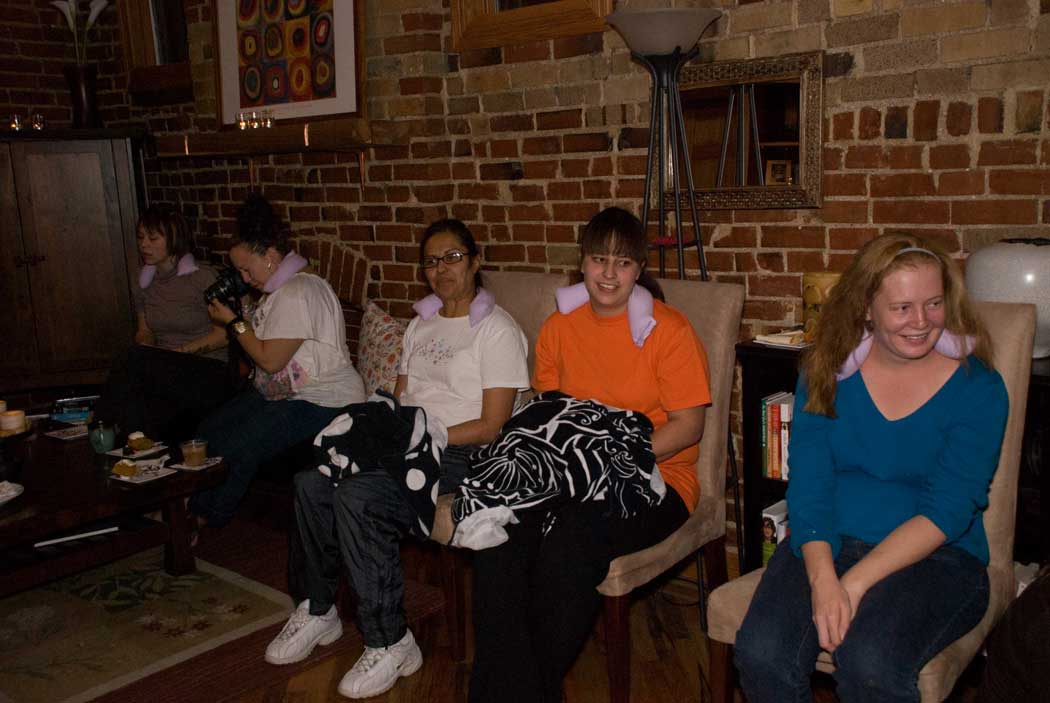

Thanks to our community group member & photographer, Elizabeth Strauss, for the photos.
(Chris)
by Chris Horst | Nov 8, 2009 | Blog |
Four months ago I found out the my master’s program was going to have an emphasis on diverse language learners. “Fancy shmancy,” I thought, “That sounds special, but really what do they have to do with teaching?” I knew what to do with diverse language learners… surround them with English, teach them some vocab, and sneak in a little grammar. Hand me that diploma, I’m good to go.
It didn’t take long until I realized that it had everything to with teaching. Everything to do with my teaching. In the last 12 years, Colorado’s public schools enrollment have grown by 12%. During that same time the amount of English Language Learners has grown by 352%.
My classroom is consistent with this growth, meaning that most of my students’ first language is something other than English. Unfortunately, many of these students have had teachers who adhered to the same beliefs I alluded to in the first paragraph. They’ve been told that their first language has no place in the classroom and the important thing for them to do is to solely focus on English. I believe that it’s critical for these students to learn English, but I’m beginning to see the social, emotional, and educational impact this approach has taken on them. Nowhere have I seen it clearer than my recent conversation with my student, Salene. It left me aching and even more committed to learning all that I can about diverse language learners.
(This conversation happened as Salene was preparing for her student-led parent-teacher conference)
Salene: I’m really nervous about my tomorrow.
Me: Why?
Salene: Well, when I lead my conference I’ll have to talk in Spanish. My parents don’t really know English and I don’t speak Spanish good anymore.
Me: Oh, I’m sure you’ll do great.
Salene: No, I really don’t remember it.
Me: Really? What do you do when you’re at home?
Salene: Well, I used to talk to them all the time when I was like three, but because school is in English I just get confused all the time. I don’t really remember Spanish anymore so I just talk to my sister because she can speak English. I just don’t really talk to my parents.
In case you’re wondering, this isn’t rare. I’m starting to hear about the loss of first language from a number of my students. Something has to change about our understanding of English Language Learners. Salene’s success in academics and English doesn’t make up for the fact that, at age nine, she’s lost her relationship with her parents.
(Alli)

by Chris Horst | Oct 22, 2009 | Blog |
I love online banking and e-commerce. I love the convenience of checking account balances, making transfers, and purchasing products in sweatpants from my living room. I’ve quickly become accustomed to the ease of doing business from home, although this luxury is unique to the past decade. It’s easy to forget that just ten years ago online banking was nothing but a dream.
Last month I visited HOPE’s work in the Dominican Republic. There, I had the privilege of meeting our clients, seeing their businesses and soaking in the culture of a country I have come to love. One of the questions I asked to a few of the community banks (groups of 15-30 clients) was “Why HOPE? Why did you choose to become a HOPE client?” Time and time again, in different communities throughout the country, our clients responded, “Because HOPE came to us.”
It’s hard to think back to what life was like ten years ago, when we had to drive to the bank or the store for just about everything. It’s even more challenging to imagine how extremely inconvenient it would be if we lived a few hours from the center of town, where a trip to the bank or to the store meant a day’s worth of travel. Yet, this is the reality for many of our clients. In Congo, our clients often live two or more hours away from the closest commercial banks, large stores, and even HOPE branch offices. To service these remote communities, our loan officers must travel two hours by bus on shoddy dirt roads or, during the rainy season, traipse hours by foot through the mud to reach these communities.
In that context, you understand why they list it as a primary reason for choosing HOPE. Our hardworking and diligent loan officers go into the communities where our clients live. This is about even more than convenience. That message—No, don’t come to us. We’ll come to you—speaks dignity, loud and clear, into the lives of our clients and into their communities. They matter. Their neighborhoods are not forgotten. When everyone tells them they aren’t, we tell them they are worth our time.
One client’s comments are still ringing in my ears. I asked him, “Why HOPE?” …and he responded, “When everybody else makes us come to them, you come to us.”

by Chris Horst | Oct 21, 2009 | Blog |
It would be inappropriate to kick off this series (“We love…”) with anything other than Southwest Airlines. Alli and I hold a deep, perhaps excessive, love of Southwest Airlines. But really, what’s not to love?

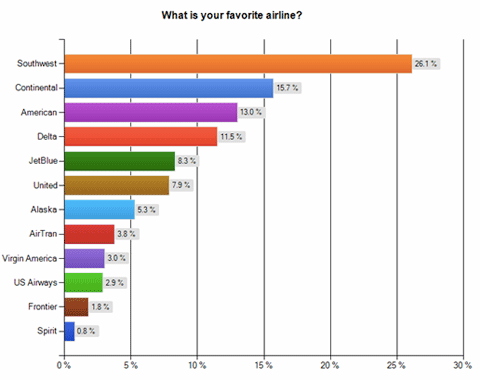
We both fly often. A few years ago we began recognizing that our flight experiences with Southwest were markedly different, in a good way, than our flights with other airlines. The whole process, from purchase to deplaning, was smoother–and even enjoyable. Our lauding should not come as a surprise. There is a reason SWA has posted a profit for 36 consecutive years (in a deeply struggling industry) and has hosted more customers than any other US airline since 2006. A recent poll (Oct 16, 2009) by Consumer Traveler echoed our feelings:
Here are a few reasons why Southwest has become like family:
- Flight attendants with personality. They are often funny, and they don’t take themselves too seriously. Here’s an example from a recent flight. “And for you, sir, hot pancakes and bacon for your in-flight breakfast meal.” – flight attendant, while handing me a bag of peanuts.
- They perform miracles. About a month ago, while traveling from Denver to the Dominican Republic (with a one-day stopover in Philadelphia), I mistakenly forgot my passport in Denver. To make a very long-story short, the Southwest crew agreed to voluntarily carry and deliver my passport to me. No other airline was willing. There was no reason for them to oblige, but they did. If they hadn’t, I would have been forced to skip the trip I was leading to the DR. Above-and-beyond.
- No seating chart. This speeds up the boarding process significantly. No looking at boarding passes while finding seats. No lag while first class passengers board. No inefficiencies. Love it.
- No bag fees. Thank you, SWA, for not nickle-and-diming me. This has many positive repercussions. For instance, passengers don’t try and carry-on six bags, resulting in the overhead bins filling up to capacity by the time the first wave of passengers has boarded.
- Cheap fares. It’s uncommon to find better fares. When you add in all the fees other airlines charge, it’s extremely rare to find better fares.
- They provide lifetime free flights to customers who write blog posts about why they love Southwest.*
*This has not yet been verified, but we’re hopeful.
